
A dues increase or an unexpected repair bill can make any homeowner pause. But one difficult month doesn’t necessarily mean an association is in trouble. The more useful question is whether the same pressures keep returning. The signs your HOA is financially unhealthy often show up as a pattern: budgets that repeatedly miss the mark, reserves that aren’t keeping pace with planned repairs, or bills delayed while the board looks for cash. Those concerns deserve a closer look, not an immediate assumption that the worst has happened.
This 2026 board checklist explains which records to review, including budgets, financial statements, reserve studies, and assessment collection reports, and how to compare them for recurring problems. It also outlines practical next steps, from tracing a transaction to assigning follow-up on incomplete reconciliations. With organized records and informed review, board members can better understand where association funds are going and make steadier decisions about future costs. Professional financial management can help bring reporting and recordkeeping into clearer order.
Key Takeaways
- Look for recurring budget gaps, shrinking reserves, and rising unpaid assessments rather than treating one unexpected expense as proof of financial distress.
- Compare financial changes over time and review supporting records to distinguish a temporary timing issue from a persistent shortfall.
- Use budgets, income statements, balance sheets, bank reconciliations, and reserve studies to assess the signs your HOA is financially unhealthy.
- When red flags appear, preserve records, reconcile figures, document questions, and assign follow-up before drawing conclusions.
- Consistent bookkeeping, accounting, and financial reporting can improve board visibility and support informed decisions about association funds.
Signs Your HOA Is Financially Unhealthy: A Practical Warning-Sign Checklist
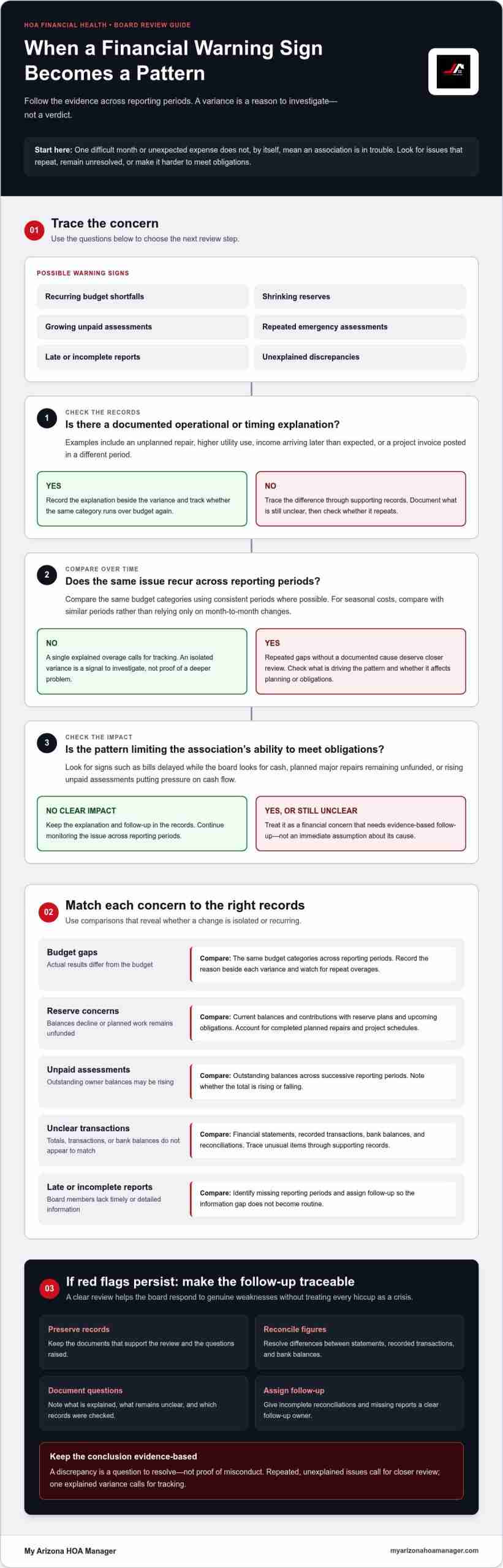
A financial warning sign deserves a calm review, not an immediate accusation. A large repair, a late payment, or a confusing statement can have an ordinary explanation. Concern grows when the same issue keeps appearing, remains unresolved, or limits the board’s ability to meet the association’s obligations. For a basic overview of how associations commonly handle operating and reserve funds, see Understanding Homeowner Associations.
Financial distress is a recurring pattern of budget pressure, inadequate funds, or unclear financial records, not one bad month. Use this checklist to identify issues that need follow-up:
- Recurring budget shortfalls: Actual expenses repeatedly exceed budgeted amounts, or expected income consistently falls short.
- Shrinking reserves: Reserve balances decline without a clear connection to completed projects, while planned major repairs remain unfunded.
- Growing unpaid assessments: More owners fall behind, or outstanding balances continue to rise, potentially putting pressure on cash flow.
- Frequent emergency assessments: Owners are asked for additional funds repeatedly to cover expenses the regular budget or reserves don’t appear to address.
- Late or incomplete reports: Board members don’t receive timely statements or enough detail to understand the association’s financial position.
- Unexplained discrepancies: Statement totals, recorded transactions, or bank balances don’t appear to match and remain unreconciled.
Budget gaps, shrinking reserves, and repeated emergency assessments
A variance between the budget and actual results isn’t automatically a crisis. The board should be able to identify what drove it, such as an unplanned repair, higher utility use, or income arriving later than expected. Record the explanation beside the variance and track whether the same category runs over budget again. Repeated gaps without a documented cause can make it harder to plan for routine operations.
Reserve declines also need context. A balance may fall after a planned repair is completed. That’s different from watching funds dwindle while major work remains on the horizon. Compare the current balance and contributions with the association’s reserve plans and upcoming obligations. Repeated special assessments can also signal that regular dues, reserve contributions, or long-term planning aren’t keeping pace with the community’s needs.
Late reports, unpaid assessments, and unclear transactions
Late or incomplete reports leave board members with less visibility when they need to make decisions. Without current information, it’s harder to see whether bills are being paid on schedule, income is keeping pace, or a developing shortfall needs attention. Identify which reporting periods are missing and assign follow-up so the gap doesn’t become routine.
Rising unpaid assessments can reduce the cash available for regular expenses, even if the budget assumes owners will pay on time. Compare outstanding balances across successive reporting periods and note whether the total is rising or falling. If a transaction looks unusual or a statement doesn’t reconcile, trace it through the supporting records and document what remains unclear. A discrepancy is a question to resolve, not proof of misconduct. An evidence-based review helps the board respond to genuine financial weaknesses without treating every hiccup as a crisis.
Why an HOA Financial Warning Sign May Be Temporary, or a Deeper Pattern
A variance is a signal to investigate, not a verdict on the association’s finances. Its meaning depends on when it occurred, whether it repeats, how much it affects the budget, and whether the records explain it. An expense above budget may reflect a repair completed earlier than planned, while a temporary cash-flow dip may stem from income arriving after bills are due. The board’s records can help distinguish these timing issues from an ongoing gap between income and obligations.
A trend across reporting periods matters more than an isolated variance because repetition can show that an assumption, funding plan, or operating cost needs a closer look. This approach helps board members assess signs your HOA is financially unhealthy without treating every unexpected change as evidence of a deeper problem.
How to tell a one-time variance from a recurring issue
Compare the same budget categories across reporting periods, using consistent periods where possible. Check whether the difference has a documented operational or timing explanation, such as a project invoice posted in a different period than expected. Then note whether the variance is limited to one line item or appears across several categories. A single explained overage calls for tracking; repeated, unexplained gaps deserve closer review.
For Arizona associations, use the community’s own budget assumptions and financial history to account for seasonal costs and project schedules. If past records show that a particular expense rises at a certain time of year, compare the current period with similar periods rather than drawing conclusions from a month-to-month change alone. For projects, compare approved schedules, invoices, and payment dates to see whether timing shifted or the total obligation changed.
How planning gaps can become financial pressure
Major repairs often require planning before the bill arrives. Compare upcoming obligations with reserve plans and current funding information. If a project is scheduled but the association’s records show no clear funding path, the board may need to revisit its assumptions and discuss options through its established procedures. Repeatedly estimating costs too low can leave less room in the operating budget and make later funding decisions more difficult.
A low monthly assessment, on its own, doesn’t show whether an HOA is healthy or distressed. Consider it alongside operating expenses, reserve planning, unpaid assessments, and known obligations. Lower dues may fit a community’s actual needs, or they may reflect assumptions that don’t account for planned work. The records provide the context.
Consistent bookkeeping, accounting, and financial reporting can make recurring results easier to compare. HOA financial management support helps organize records so board discussions can focus on documented patterns rather than a single surprising figure.
How to Check HOA Financial Health Against Budgets, Statements, and Reserves
A single balance can look reassuring or alarming without showing the full picture. To assess whether the signs your HOA is financially unhealthy reflect a real concern, compare multiple records for the same reporting period and trace important figures back to supporting documents. This gives the board a clearer view of operating performance, available cash, and future obligations.
| Financial area | Healthier signal | Warning signal | Record to review |
|---|---|---|---|
| Operating budget | Income and expenses generally track planned amounts, with variances explained. | Repeated gaps or changes without a clear explanation. | Approved budget and budget-to-actual report |
| Income statement | Revenue and expenses are clearly categorized for the period. | Recurring operating losses or unclear shifts between categories. | Monthly or periodic income statement |
| Balance sheet | Assets and liabilities are presented clearly and make sense alongside current obligations. | Balances or liabilities that are difficult to explain or verify. | Balance sheet and supporting schedules |
| Bank reconciliation | Reported cash accounts agree with bank activity after outstanding items are accounted for. | Unresolved differences or missing reconciliations. | Bank statements and reconciliation reports |
| Reserve planning | Contributions and expected projects align with the association’s reserve study. | Planned work lacks a clear funding path or reserve assumptions are outdated. | Reserve study, funding records, and project plans |
What budgets and financial statements can reveal
A budget-to-actual report shows where results differ from the approved plan. Review each variance alongside invoices, contracts, owner receipts, or other supporting records to understand what changed. The income statement answers a different question: how much revenue came in and what the association spent during a period. The balance sheet offers a snapshot of assets, liabilities, and the association’s financial position on a particular date.
Cash figures need a second look. Compare the cash reported in the financial statements with bank statements and reconciliation reports for the same date. Timing items, such as outstanding checks or deposits in transit, may explain a difference, but they should be documented and cleared through the normal process. For additional context on Arizona association finances, see this Arizona HOA financial management reference.
How to assess reserve planning and financial controls
Compare planned reserve contributions and upcoming projects with the association’s reserve study. Note whether the study’s assumptions still match the community’s project schedule and whether the budget reflects those plans. A reserve balance alone can’t show whether future work is adequately planned or funded.
Review the process behind the numbers, too. Check that transactions have supporting documentation, reconciliations are completed, and financial duties include appropriate review and approval steps. Clear separation of responsibilities can make errors easier to catch and records easier to follow. For related governance considerations, review the association’s established financial procedures and board records.
What an HOA Board Can Do When Financial Red Flags Appear
A measured response protects the association’s records and keeps the review focused on facts. A discrepancy may result from timing, coding, or an incomplete report, so avoid assigning blame before the board understands what the documents show. Follow the association’s governing procedures for financial review and board discussion, and keep a clear record of the steps taken.
A measured first-response checklist for board members
Use a consistent process so questions don’t get lost between meetings. Preserve source documents, note what needs clarification, and assign follow-up through the board’s usual channels. The goal is a documented explanation and a clear next step, not a premature conclusion about why a figure changed.
- Preserve the records. Gather relevant financial reports, invoices, contracts, meeting minutes, bank records, and the budget assumptions tied to the period under review. Keep copies together so the board is working from the same information.
- Reconcile the figures. Trace the amount in question from the report to its supporting record. Compare related totals, note timing differences, and identify any reconciliation that remains incomplete.
- Document specific questions. Instead of recording “the expenses look wrong,” note which account, transaction, or reporting period needs an explanation and what supporting detail is missing.
- Assign follow-up and set a review date. Identify who will obtain or organize the requested information, when the board will revisit it, and how unresolved items will be tracked in meeting records.
Discuss the findings as a board using the evidence and the association’s established procedures. Share accurate updates with residents through appropriate channels, while avoiding speculation or disclosure of information that isn’t authorized for release. This calm approach is especially useful when potential signs your HOA is financially unhealthy are still being checked.
When to bring in outside financial expertise
Consider qualified accounting or financial management support if discrepancies persist, reconciliations remain incomplete, or reports are too difficult for board members to interpret. An independent review can help clarify accounting questions and improve reporting without implying that anyone acted improperly. If the issue raises legal questions about the association’s obligations or procedures, seek advice from qualified legal counsel rather than relying on a financial interpretation alone.
Keep the scope clear: identify the records or questions that need review, and preserve the board’s decision-making process. Consistent bookkeeping, accounting, and financial reporting can also make routine oversight easier by giving board members organized information to review.
If your board needs more consistent financial records and reporting, explore professional HOA financial management to support clearer oversight and follow-through.
How Arizona HOA Financial Management Can Improve Visibility and Follow-Through
Once a board has identified possible signs your HOA is financially unhealthy, dependable processes can help turn questions into a clearer picture. Consistent bookkeeping, accounting, and financial reporting give board members an organized view of income, expenses, cash balances, and outstanding assessments. They can compare results with the budget, track open questions, and see how current decisions relate to planned obligations.
Financial management isn’t only about investigating a concern. Regular records also help the board follow routine activity, understand what has changed, and return to unresolved items with the right documentation. That visibility supports calmer, better-informed decisions, especially when financial questions have come up across several reporting periods.
What consistent financial management can support
Bookkeeping records transactions consistently, while accounting and financial reporting help present that information in a usable form. With organized reports, board members can review budget performance, monitor assessment balances, and compare available funds with upcoming obligations. Clear records also make it easier to trace a figure back to its supporting documentation when a question arises.
Steady administrative follow-through matters, too. A documented question can be assigned, reviewed, and tracked rather than getting lost between meetings. My Arizona HOA Manager provides community and financial management for Arizona associations, including bookkeeping, accounting, and financial reporting. The firm brings more than 30 years of industry experience to this work.
- Organized records help connect financial reports to supporting transactions.
- Consistent reporting gives board members a clearer basis for reviewing budgets and outstanding assessments.
- Documented follow-up helps keep open financial questions visible through board discussions.
A practical next step for Arizona community boards
Before discussing support, summarize the board’s concerns and gather the records that relate to them. This might include recent financial statements, budget comparisons, bank reconciliations, reserve information, assessment balances, or notes on planned projects. A concise list of questions helps keep the conversation focused on the association’s needs and the gaps the board wants to address.
Community management can support steadier financial administration by coordinating routine records and reporting with broader association operations. For a board, that means having a more consistent process for reviewing financial information and following up on outstanding questions. It doesn’t replace board oversight; it gives board members clearer information to use in that role.
My Arizona HOA Manager offers community and financial management support to associations in Scottsdale, Phoenix, Mesa, Tucson, Glendale, Chandler, Avondale, Litchfield Park, Maricopa, Goodyear, Surprise, Peoria, Tempe, Fountain Hills, Cave Creek, and Anthem. If your board is looking for a more organized approach to financial visibility and follow-through, explore Arizona HOA management support.
Build a Steadier Financial Review for Your Community
Healthy oversight doesn’t end when one discrepancy is resolved. Boards can make financial review part of their regular rhythm, with clear expectations for what information they’ll receive, how questions will be tracked, and when unresolved items return for discussion. That steady approach helps the board respond thoughtfully if new signs your HOA is financially unhealthy appear, rather than scrambling only when an urgent decision is already on the table.
For Arizona communities, dependable administrative support can help keep financial processes and resident communication organized. My Arizona HOA Manager’s online resident portals support community operations, while community and financial management helps boards maintain visibility and follow-through. A consistent process can make financial oversight feel manageable, not overwhelming.
Explore community and financial management support and take a practical next step toward clearer, steadier HOA operations. Your board can build confidence one well-informed decision at a time.
Frequently Asked Questions
Does a low HOA fee mean the association is financially healthy?
No. A low fee may reflect efficient operations, but it could also mean the budget leaves out future needs or that planned maintenance is being deferred. Consider what the fee covers, the condition and age of shared assets, and whether the association has a realistic plan for upcoming expenses. Comparing fees alone with another community won’t show whether either association is adequately prepared for its own obligations.
Can an HOA have a positive bank balance and still be financially unhealthy?
Yes. A positive balance is only a snapshot and may not show what the association owes or needs to fund next. For example, cash on hand may be needed for upcoming bills, committed projects, or other obligations. Some funds may also be designated for specific purposes. To assess the signs your HOA is financially unhealthy, consider cash alongside liabilities, operating results, reserve plans, and upcoming expenses.
Are special assessments always a sign of poor HOA financial management?
No. A special assessment may address an unexpected event or a large project that wasn’t practical to fund through regular dues alone. The useful questions are whether the board can explain the need and how the decision fits the association’s plans and governing procedures. If assessments recur for routine costs, that pattern may prompt a closer look at budgeting, reserve planning, or expense assumptions.
How can homeowners raise financial concerns without accusing the board?
Frame the concern around a specific document or question, not a conclusion about anyone’s actions. For instance, ask why a particular expense changed between two reports or where a balance appears in the budget. Use the association’s established process for submitting questions or requesting records, and keep the tone factual. A clear, courteous inquiry makes it easier for board members to respond with relevant information.
What should an HOA do if financial reports contain unexplained discrepancies?
First, identify the exact report, account, period, and amount that don’t appear to match. The treasurer or assigned reviewer can trace the figure to supporting records, such as a bank entry, invoice, or ledger posting, and note any timing or categorization differences. If the discrepancy remains unresolved, record the question and its follow-up in the board’s normal review process. Avoid treating an unexplained difference as proof of wrongdoing.
Can professional HOA management help an association improve financial visibility?
Yes. Professional management can support more organized bookkeeping, accounting, and financial reporting, helping board members understand activity and follow open questions. A consistent process can make it easier to review records, prepare for discussions, and keep financial information accessible through community operations. For boards in Arizona communities, including Phoenix and Tucson, this support can complement board oversight and help turn scattered information into a clearer working picture.
How can an Arizona HOA account for seasonal expenses when planning its budget?
Use the association’s own records to compare expenses across similar months or seasons, rather than assuming every period will look alike. Review past utility bills, landscape-related expenses, and maintenance invoices alongside project schedules and budget assumptions. Note when seasonal costs tend to occur and build those expectations into the next planning cycle. This can help boards distinguish predictable fluctuations from a new expense pattern that needs further review.