
Protecting resident information isn’t about locking every record away. It’s about deciding who needs access, why they need it, and how long they should have it. Arizona HOA boards share records to collect assessments, respond to homeowner questions, and manage community business. But every spreadsheet, portal, email, and vendor handoff can create an opportunity for information to be mishandled. HOA data security and resident privacy depend on governing access, purpose, retention, and response together, not simply choosing a digital platform. Boards need to handle financial and contact details carefully while meeting legitimate recordkeeping needs.
This guide explains what information an association may handle, where exposure can arise, and how to set practical rules for access, sharing, retention, and incident response. It also covers how consistent management procedures, financial administration, and resident portals can support board oversight without treating a portal as a security guarantee. The goal isn’t to make records inaccessible. It’s to make responsibility clear before a problem occurs, so community business can move forward while resident information receives careful handling.
Key Takeaways
- HOA data security and resident privacy improve when boards define how information is collected, used, shared, stored, and disposed of.
- Map how records move through the association and clarify which board members, managers, staff, or service providers need access for their roles.
- Compare informal handling with documented controls to spot gaps in access reviews, recordkeeping, training, vendor coordination, and incident escalation.
- Build a practical plan by inventorying records, assigning owners, limiting permissions, setting retention practices, training people, and reviewing the process.
- Community management can support organized records and financial administration, while the board retains oversight and approves policies and responsibilities.
What HOA data security and resident privacy mean for Arizona communities
An Arizona HOA board has to balance the need to use resident information for assessments, requests, and community operations with the need to limit unnecessary exposure. Privacy concerns whether information is collected and used appropriately. Security concerns protecting it from unauthorized access, loss, or misuse. HOA data security and resident privacy work together, but they answer different questions: should the association have or use this information, and how will it protect the information it holds?
A documented process gives board members and managers a shared reference instead of leaving decisions to habit or individual judgment. It can identify the records the association handles, who needs them for a defined task, how information is shared, and when records should be reviewed or disposed of. This is a practical governance framework, not a conclusion about every legal requirement. Applicable obligations can depend on the type of record and the circumstances, so boards should distinguish legal review from day-to-day procedures.
Begin with the records themselves. An association might hold contact details for communications, payment records for assessment administration, architectural submissions for property requests, meeting materials and correspondence for governance, and transaction documents for resale administration. The exact mix varies by community and by how its work is organized.
What information does an Arizona HOA typically handle?
Group records by purpose before deciding how to handle them. Routine contact information, such as a resident’s mailing address or preferred communication details, differs from financial records or documents that contain other sensitive personal information. That distinction can guide who needs access and how carefully records should be shared. A basic inventory should identify each record category, its business purpose, where it is kept, and the roles that use it. Don’t assume every association maintains the same records or needs identical controls.
- Communications: contact details, notices, and resident correspondence.
- Assessments: payment histories and related financial records.
- Governance: board materials, minutes, and community correspondence.
- Property requests: architectural submissions and related communications.
- Resale administration: records assembled or handled during a property transaction.
Why resident privacy is a governance issue
Residents trust the board to handle information for legitimate community purposes. Clear practices support that trust and keep routine work orderly: people know where records belong, how they should be used, and who is responsible for decisions. Unnecessary collection creates information the association must manage. Broad access can expose records to people with no work-related reason to see them. Boards can reduce both risks by setting expectations before a concern arises.
HOA data governance is the set of rules and oversight that guides how an association collects, uses, shares, retains, and disposes of information. Boards can explore Data governance principles as a foundation, then shape procedures around their community’s actual records and responsibilities.
This groundwork makes later decisions more consistent. An inventory can reveal where records move and where access needs clarification. Documented responsibilities give the board a practical basis for reviewing information-handling practices over time.
How resident information moves through an Arizona HOA
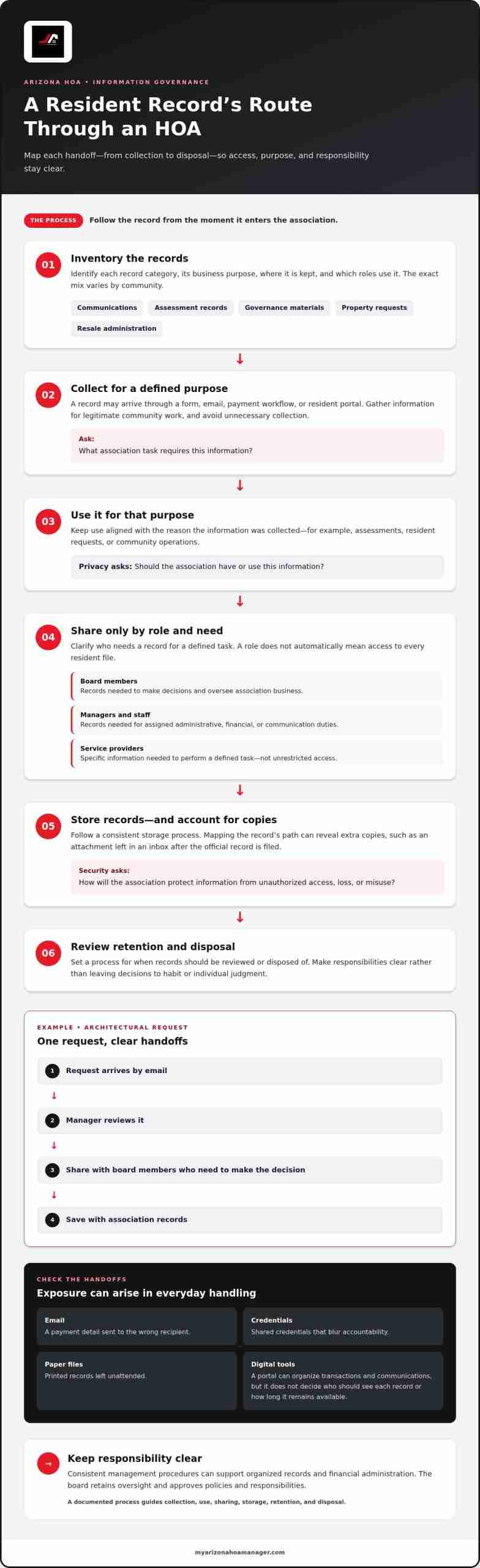
A resident record rarely stays in one place. An architectural request might arrive by email, go to a manager for review, be shared with board members who need to make a decision, and then be saved with association records. At each handoff, ask two practical questions: who needs this information for their role, and what should happen to it next?
Map a record’s path from start to finish. Collection may happen through a form, email, payment workflow, or resident portal. Use should match the purpose for collecting the information. Share it only with people who need it, and follow an established process for storage, retention, and disposal. Mapping the steps can expose overlooked copies, such as an attachment left in an inbox after the official record has been filed.
- Board members may need records to make decisions and oversee association business, but that doesn’t mean they need automatic access to every resident file.
- Managers and staff may handle records as part of assigned administrative, financial, or communication duties.
- Service providers may receive specific information to perform a defined task. That role shouldn’t imply unrestricted access.
Digital tools and paper records both create exposure points. A portal can bring community transactions and communications into one place, but the platform itself doesn’t determine who should see each record or how long it should remain available. An email can send a payment detail to the wrong recipient. Shared credentials can blur accountability. Printed files left unattended can be viewed or misplaced. Excess permissions can also leave former board or staff members with access after their responsibilities change.
Where can resident information be exposed?
Exposure can result from an honest mistake, a compromised account, a lost paper file, or deliberate unauthorized access. For example, an architectural submission intended for a review group might be forwarded to a broader mailing list, or a printed assessment report might be left in a shared workspace. These scenarios call for controls across the information lifecycle, not just a digital platform: clear sharing practices, role-based access, careful file handling, and a routine for removing access when roles change.
Which Arizona and federal rules may apply?
Applicable requirements depend on the information involved, the association’s activities, and the circumstances. Arizona’s breach-notification statutes, A.R.S. §§ 18-551 and 18-552, address certain breaches involving unencrypted computerized personal information. For a breach that meets the statutory criteria, organizations, including HOAs, generally must notify affected Arizona residents within 45 days after determining that a breach occurred. If more than 1,000 Arizona residents are affected, additional notifications are required to specified agencies and consumer reporting agencies. Not every lost record or mistaken email necessarily meets the law’s definition, so boards should not assume whether notification is required.
Federal requirements may also depend on the type of information or activity, but this overview doesn’t determine which rules apply to a specific association. It isn’t legal advice. For an incident or a question about applicable duties, consult qualified legal counsel. Consistent community management processes can help keep record handling and board oversight organized, while legal determinations remain a separate matter.
Compare HOA data security approaches: informal handling or governed controls?
Informal practices can feel efficient in a small community: a board member keeps a spreadsheet, the treasurer manages payment records, and people rely on experience to know what to share. The weakness is that important expectations may exist only in someone’s memory. Documented controls make responsibilities visible and repeatable, whether tasks sit with volunteers, staff, or a management team. Neither approach is automatically secure. Results depend on clear ownership and follow-through.
The right level of process depends on the association. A community with a small volume of records and limited financial activity may need a simpler framework than one handling extensive transactions, frequent resident requests, or records managed by many people. Volunteer turnover matters, too. A process that works only because one long-serving board member knows where everything is can become fragile when that person leaves.
| Area | Informal handling | Governed controls |
|---|---|---|
| Ownership | Responsibilities are understood verbally or assumed. | Named roles clarify who maintains records and who oversees decisions. |
| Access review | Access may continue by habit after duties change. | Assigned access is reviewed when roles change and on a defined schedule. |
| Recordkeeping | Files may be saved in personal inboxes or scattered folders. | Procedures identify official record locations and handling expectations. |
| Training | People learn by watching others or asking as issues arise. | Written guidance gives board members and staff a consistent reference. |
| Vendor coordination | Information sharing may depend on individual judgment. | Responsibilities and permitted information sharing are documented. |
| Incident escalation | People may be unsure whom to tell or what to preserve. | A defined reporting path helps concerns reach responsible decision-makers. |
What changes when privacy practices are documented?
An approved policy turns unwritten expectations into a working reference. It can name responsible roles, set access-review expectations, and include a review date so procedures don’t become stale. Written roles also help incoming board members understand what they oversee without inheriting access simply because a predecessor had it. A security tool can support protection, but a governance process defines who uses information, for what purpose, and who checks that practice.
How should a board evaluate management support?
Look for clear assignments across resident communications, records administration, and financial workflows. Management support can coordinate consistent procedures and orderly records, while the board retains oversight, approves appropriate policies, and reviews whether responsibilities are being followed. An online resident portal can be part of that workflow, not a substitute for defined access and recordkeeping practices. A useful Arizona homeowner association management guide should also clarify how management and board responsibilities work together.
For HOA data security and resident privacy, compare the actual process, not just the organizational model. Check whether owners are named, role changes trigger access reviews, records have consistent handling expectations, and staff or volunteers know how to raise a concern. Those answers show whether the approach can keep working as the community’s records, financial activity, and leadership change.
A practical Arizona HOA plan for protecting resident information
A workable plan doesn’t need to start with new technology. Start by identifying the records, assigning responsibility, and setting clear routines people can follow. For HOA data security and resident privacy, the board can organize the work into phases, then revisit the process as records, vendors, and community responsibilities change.
- Inventory records. List the main information categories, where each is kept, its purpose, and the roles that use it. Include paper files, email, payment workflows, and portal records.
- Assign owners and limit access. Name a person or role accountable for each category. Give board members, managers, staff, and service providers access according to their assigned work, not convenience. Use individual accounts where available, avoid shared credentials, and remove permissions promptly when a person’s role changes.
- Document handling and retention. Set approved methods for sharing records, identify where official copies belong, and establish a retention schedule. Store paper files in controlled locations. Dispose of records under the association’s approved process, using shredding for paper and appropriate erasure or other methods for digital records.
- Train and review. Make expectations easy to find. Cover routine practices such as checking recipients before sending attachments, protecting account credentials, and reporting misplaced files. Review access, responsibilities, and procedures on a scheduled basis.
What should the board do in its first 30 days?
Start with a practical inventory and identify who handles each record category. Compare current access with those responsibilities, then remove permissions that are no longer needed. Assign a board owner to coordinate oversight and set a date to review the written procedures. This first pass won’t answer every policy question, but it gives the board a clear starting point and a way to track follow-up work.
Keep the scope manageable. Prioritize records tied to financial activity and resident communications, then work through other categories. Record open questions rather than relying on assumptions, especially where responsibilities overlap between volunteers, management, staff, and service providers.
How can an HOA prepare for a suspected data incident?
Write down who receives an incident report and who coordinates the initial response. Make the first steps practical: contain further exposure where possible, preserve relevant records and messages, document what is known and when, and promptly notify the designated board and management contacts. Avoid deleting files or making broad statements before the facts are understood.
Prompt escalation supports an informed response; it can’t guarantee that an incident will be prevented or resolved. Keep immediate containment and documentation separate from legal decisions about whether notice is required, whom to notify, and when. Those decisions depend on the facts and applicable requirements, so involve qualified legal counsel promptly when a suspected incident could affect personal information.
Clear, repeatable processes can connect the board’s oversight with organized records and financial administration. Explore HOA management support to put consistent community and financial management practices in place.
How Arizona community management can support consistent privacy practices
Privacy procedures are easier to follow when everyday community work has clear handoffs. Community management can organize resident communications, association records, board procedures, and financial administration so information moves through known workflows rather than scattered habits. For example, a consistent process can clarify where payment records are maintained, who prepares routine communications, and how requests or documents are routed for board review.
This support makes responsibilities easier to track, but it doesn’t transfer the board’s oversight role. The board approves appropriate policies, assigns responsibilities, and reviews whether the association’s practices fit its needs. Management coordinates administrative work within those approved procedures. Legal interpretations and cybersecurity technology are separate matters, and administrative coordination should not be mistaken for either.
An online resident portal can serve as a channel for payments, documents, or communications. Its role should fit into the association’s wider information-handling practices: board-approved expectations still need to guide what information is collected, who handles it, and how records are retained. A portal is a useful part of a broader process, not a standalone guarantee of privacy or security.
Where management processes fit in the privacy framework
Consistent workflows connect records to the work they support. A manager handling a resident request can follow the association’s process for routing it, while financial administration can keep payment-related records organized according to assigned responsibilities. Boards reviewing HOA financial management in Arizona can consider how payment records are handled alongside other association records, while keeping access and oversight expectations clear. The goal is orderly administration, not unrestricted access.
For practical oversight, document which tasks management coordinates, which decisions require board direction, and how questions or unusual requests are escalated. When the same process is followed across routine tasks, board members have a clearer basis for checking whether records are handled consistently. It also gives new volunteers a reference instead of leaving them to reconstruct informal practices.
What boards can review with a community-management partner
A useful review focuses on boundaries and working procedures. The board and its management partner can discuss:
- Resident records: which administrative roles handle records and how requests are routed.
- Financial workflows: how payment-related information is organized and which responsibilities belong to management or the board.
- Communications: how resident messages and documents are prepared, shared, and retained under association procedures.
- Oversight: how board-approved policies guide routine work and how responsibilities are revisited when roles change.
These conversations help distinguish day-to-day coordination from decisions the board must make and oversee. That clarity supports HOA data security and resident privacy without suggesting management alone can eliminate risk. Arizona boards in Scottsdale, Phoenix, Mesa, Tucson, Glendale, Chandler, Avondale, Litchfield Park, Maricopa, Goodyear, Surprise, Peoria, Tempe, Fountain Hills, Cave Creek, and Anthem can use community-management support to align records, financial administration, and resident communications with board-approved procedures.
Make consistent information practices part of your next board priority
Resident information practices are strongest when they’re maintained as part of regular community operations, not treated as a one-time project. Set a review date, revisit responsibilities when leadership changes, and keep procedures aligned with how the association actually works. That steady attention makes HOA data security and resident privacy a practical part of accountable community management.
My Arizona HOA Manager provides community and financial management, including online resident portals. These services support organized administration, while the board retains oversight and approves the policies that guide its association. Discuss how management workflows can fit your community’s records, financial processes, and resident communications.
Explore community management support for your Arizona HOA and take a measured step toward clearer, more consistent practices. With shared expectations and steady oversight, your board can build a dependable foundation for the community’s information responsibilities.
Frequently Asked Questions
What personal information does an HOA collect about residents?
An HOA may collect names, mailing and email addresses, phone numbers, assessment payment details, meeting records, architectural applications, and resident correspondence. Some associations also handle resale materials or emergency contact details; others don’t. Before setting access rules, map each information category to its purpose and storage location. Practices vary among communities in Phoenix, Scottsdale, Mesa, Tucson, Glendale, Chandler, Avondale, Litchfield Park, Maricopa, Goodyear, Surprise, Peoria, Tempe, Fountain Hills, Cave Creek, and Anthem.
Is an HOA responsible for protecting residents’ personal information?
Yes. The board has a governance role in overseeing how the association handles resident information and establishing reasonable safeguards. Specific legal obligations can depend on the information involved, the association’s activities, and the circumstances. A board can document its practices and clarify who is responsible for routine handling, but that doesn’t settle every legal question. For advice about a specific duty or incident, consult qualified legal counsel.
Can HOA board members share a homeowner’s information with other residents?
They should share a homeowner’s information only when there’s a legitimate association purpose and the disclosure follows governing documents, board-approved policies, and applicable law. For example, a board may need to circulate relevant details to address a community matter, but that doesn’t automatically justify sharing an entire file. Before distributing information, identify the purpose, intended recipients, and minimum details needed, then use an appropriate association communication channel.
What should an HOA do if resident information is exposed?
Report the concern promptly through the association’s designated internal contact, and have responsible people limit further exposure where practical. Preserve relevant messages, files, and a timeline of what’s known. Avoid deleting potential evidence or speculating about the cause. Notify the appropriate board and management contacts, then seek qualified legal guidance to assess next steps. Whether residents or agencies must be notified depends on the information and the circumstances.
How often should an HOA review its data security practices?
Set a recurring review date in the association’s procedures, then revisit practices sooner after a material change. Examples include switching a recordkeeping system, changing a service provider, revising a payment workflow, or handing responsibilities to new board members. A review can check whether assigned roles still match actual work and whether old permissions or outdated instructions remain. The appropriate cadence depends on the association; don’t assume a universal legally required schedule.
Does an online resident portal make HOA information secure?
No single portal can establish that all association information is secure. A portal may provide a channel for transactions and documents, but boards still need clear rules for account access, information sharing, record retention, and oversight responsibilities. The platform’s actual safeguards also matter. Treat the portal as one element of the association’s information practices, and include it in routine reviews rather than relying on its presence alone.
What is the difference between HOA data privacy and data security?
Privacy concerns whether the association collects, uses, or shares information appropriately. Security concerns how it protects that information from unauthorized access, loss, or misuse. For example, deciding which board roles need an assessment record is a privacy question. Protecting the record from access by people without an assigned reason is a security question. HOA data security and resident privacy work together, but each calls for its own clear decisions and practices.