
What if the biggest risk in changing HOA managers isn’t the change itself, but an unclear handoff? An HOA management transition plan helps your Arizona board keep records, finances, vendor work, and resident support moving as responsibilities shift.
Your board likely knows a transition takes coordination. The challenge is deciding who owns each task, when it needs to happen, and how to keep residents informed. Notice periods, approvals, and timing can depend on your management agreement and governing documents, so map them out before setting a cutover date.
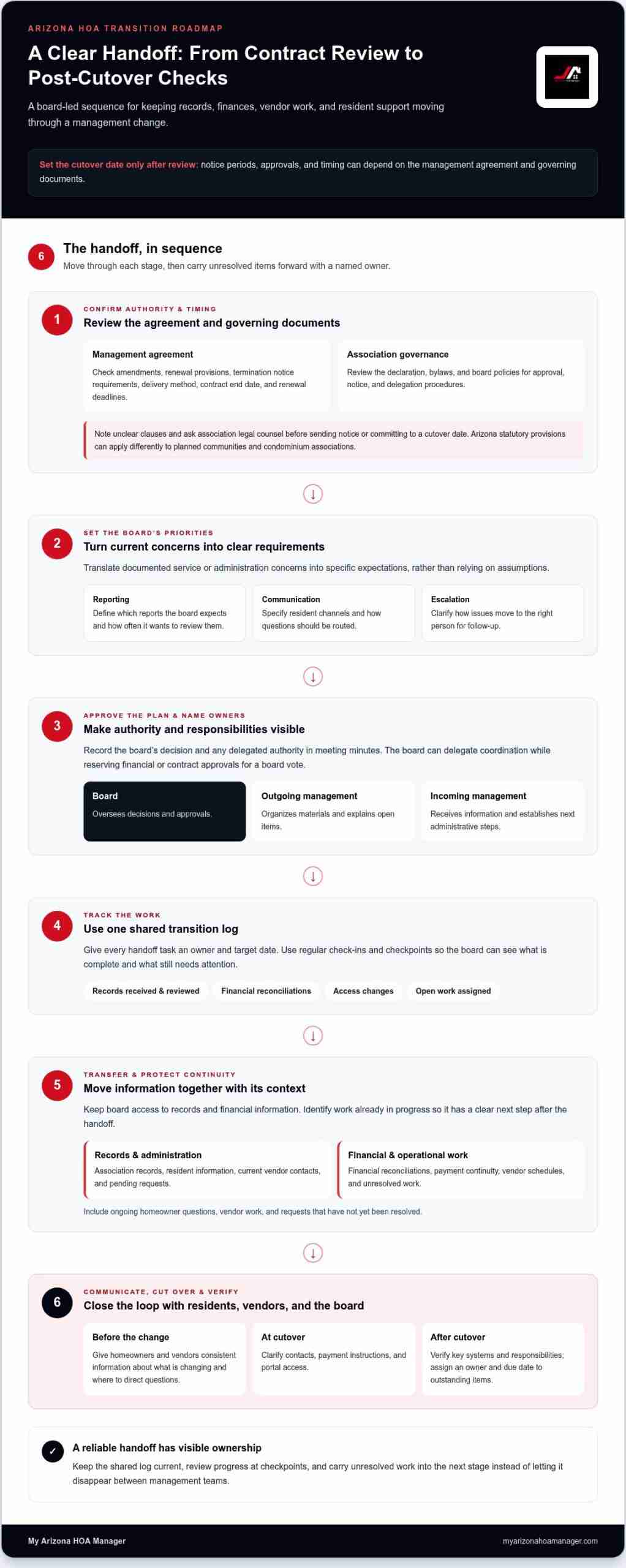
This checklist lays out the handoff in sequence, with responsibilities and milestones for the board and both management teams. It covers what to gather and transfer, how to maintain continuity in bookkeeping and payments, and what to communicate about contacts, payment instructions, and portal access. It also explains why complete records matter for ongoing association administration, including resale documents. A shared log and regular check-ins give the board a clear view of what’s complete and what still needs attention.
Key Takeaways
- Build your HOA management transition plan around a board-approved timeline, named task owners, and clear milestones.
- Review the management agreement and governing documents before setting the termination date or assigning authority.
- Use a shared transition log to track records, financial reconciliations, access changes, and unresolved work.
- Prepare consistent messages so homeowners and vendors know what is changing and where to direct questions.
- After cutover, verify key systems and responsibilities, then assign owners and due dates to anything outstanding.
Why an HOA Management Transition Plan Matters for Arizona Boards
An HOA management transition plan is a board-approved sequence for ending one management relationship and starting another. It assigns responsibilities, sets timing, and identifies checkpoints for the handoff. This gives the board a practical way to oversee association records, financial administration, resident information, and open operational items. Instead of treating a manager change as a simple vendor swap, the board can manage it as a governance and service decision.
Management touches the association’s day-to-day work. A bank reconciliation, a homeowner question, a vendor schedule, or an unresolved architectural request may all be in progress when management changes. If no one owns the transfer, the board can lose track of what is complete and what still needs attention. A written sequence makes responsibilities visible without assuming every transition follows the same timetable.
An overview of homeowner associations helps explain why management and board oversight are connected: the association operates through its governance structure, while management supports its administrative work. In Arizona, ground transition decisions in the community’s governing documents, management agreement, and approved priorities. The plan helps carry out those decisions, but does not replace them.
What should an HOA management transition plan accomplish?
The plan should set a target timeline, name a task owner, and identify checkpoints where the board can review progress. It should preserve board access to records and financial information, and make clear how residents and vendors can direct routine questions. For example, the board can track whether account records, current vendor contacts, and pending requests have been received, reviewed, and assigned.
Make ownership explicit. Board members oversee approvals and decisions; outgoing management organizes materials and explains open items; incoming management receives information and establishes the next administrative steps. The exact division depends on the agreement and the board’s direction. A shared checklist helps surface gaps early, before they become post-transition surprises.
When should an Arizona HOA consider changing management?
Recurring gaps in service, communication, financial reporting, or routine administration may be reasons to evaluate whether the current arrangement meets the community’s needs. Look for patterns documented over time, such as repeated delays in receiving reports or unclear follow-through on resident requests. A single missed update or operational hiccup may call for correction, not an immediate management change.
Start with the record. Review relevant board minutes, correspondence, reports, and previous follow-up so the discussion is based on specific concerns rather than frustration alone. Then compare the association’s needs with its governing documents, management agreement, and board-approved priorities. This gives directors a clearer basis for deciding whether to address performance concerns, adjust expectations, or plan a new management relationship.
The goal is a deliberate handoff that keeps governance decisions with the board and gives administrative work a clear path forward. Turn that goal into an ordered checklist, with each task assigned to an owner and a target date.
Before the Handoff: Confirm Board Authority, Contract Terms, and Arizona Requirements
Before choosing a cutover date, establish what the board is authorized to do and what the current management agreement requires. The agreement may specify a notice period, delivery method, renewal terms, or contract end date. Checking these details first helps avoid timing and coordination problems.
Confirm how the decision will be made and recorded. Follow the association’s governing documents and applicable law, and document the board’s decision and any delegated authority in the meeting minutes. For example, the board may authorize designated directors to coordinate the handoff while reserving financial or contract approvals for a board vote. Clear boundaries show everyone who can act on the association’s behalf.
Before beginning a new management relationship, translate current concerns into specific needs. If reports have been hard to review, define which reports the board expects and how often it wants to review them. If resident questions are routed inconsistently, specify communication channels and escalation paths. A written scope helps prevent both sides from relying on assumptions.
How should a board review its management agreement?
Read the full agreement, including amendments and renewal provisions. Note the termination notice requirements, contract end date, required delivery method, and deadlines tied to renewal. Look for language about association records, funds, open work, and cooperation during a transition. List unclear clauses and bring those questions to the association’s legal counsel before sending notice or committing to a cutover date.
Which Arizona governance documents and requirements should be reviewed?
Review the declaration, bylaws, board policies, and management agreement for procedures that affect approvals, notices, or delegation. Arizona statutory provisions can differ in their application to planned communities and condominium associations, so identify which structure applies before relying on a statute. Treat legal references as review points, not assumptions. Have qualified counsel verify current Arizona Revised Statutes citations and their applicability to the association’s situation.
How can the board define requirements for the incoming manager?
Turn the community’s priorities into a concise scope. Specify the financial reporting, bookkeeping, resident access, and resale-document administration the board needs, along with communication channels, handoff meetings, and tracking for unresolved items. State who will provide and receive each category of information. This Arizona HOA management guide offers a reference for broader board responsibilities.
- Financial administration: Identify the reports, reconciliations, and account information the board expects to review.
- Resident access: Define how homeowners will receive routine updates and find community information.
- Open matters: Set expectations for documenting pending requests, vendor coordination, and unresolved decisions.
Use the written scope to align the agreement, board expectations, and transition responsibilities before the handoff begins. My Arizona HOA Manager provides community and financial management, including bookkeeping, accounting, and financial reporting, to support board-directed association administration. Learn more about My Arizona HOA Manager.
HOA Management Transition Checklist: Transfer Records, Funds, and Open Work
A useful HOA management transition plan turns a broad handoff into trackable tasks. Put each task in a shared, board-visible log with a responsible party, target completion date, status, and evidence of completion. “Received” or “updated” is more useful when paired with a note showing what arrived, which access changed, or which reconciliation was reviewed. Tailor the inventory to the association’s records and systems rather than assuming every community uses the same tools.
What association records should be included in the handoff?
Ask the outgoing manager to organize records by category, and have the incoming manager or a board designee record receipt. The inventory may include governing documents, board minutes, policies, owner rosters, current administrative records, vendor contracts and contacts, insurance information, active projects, and pending board decisions. Include records the association actually maintains, and note where digital files are stored or physical materials are delivered.
- Outgoing manager: Prepare the agreed records and identify missing or incomplete items.
- Incoming manager or board designee: Mark each category received, review it for obvious gaps, and record follow-up ownership and dates.
A receipt log gives the board a clear view of what has transferred and what remains outstanding. For communities handling home sales during the change, pay particular attention to records needed for resale-document administration.
How should boards manage financial and account access?
Coordinate financial access with authorized board representatives and the people responsible for the association’s bookkeeping and reporting. Track the status of bank and payment access, outstanding assessments, payables, deposits, reconciliations, and upcoming financial deadlines. Systems and procedures vary by association, so record the relevant accounts and platforms instead of relying on a generic checklist.
- Board representative: Confirm who is authorized to approve or oversee access changes.
- Outgoing and incoming managers: Coordinate the transfer of financial records and note which reconciliations or reports remain due.
- Assigned owner: Record completion evidence, such as access confirmation or a reconciliation review, without placing passwords in the log.
Use secure procedures to update users and credentials. Don’t send passwords through open email threads or shared notes. Consistent bookkeeping, accounting, and reporting help the board follow the financial handoff. The Arizona HOA financial management reference offers related guidance for board oversight.
How can the board transfer open work without losing context?
Create an open-items register for pending owner requests, vendor work, projects, disputes, and time-sensitive administrative tasks. For each item, capture its status, brief background, next action, responsible party, and target date. For example, a pending vendor repair entry should show what has been arranged, what decision or follow-up remains, and who will take the next step. Avoid recording sensitive details beyond what the task requires.
Hold a structured handoff meeting with the outgoing manager, incoming manager, and relevant board representatives to review the register. Record decisions, unresolved questions, and due dates in the log, then assign each follow-up to a named owner. This gives the board a practical way to monitor outstanding work after records and access have changed hands.
Keep Arizona Homeowners and Vendors Informed During the Management Change
A clear communication sequence helps residents know where to pay and whom to contact, and helps vendors avoid waiting for approval from the wrong person. Build a communication calendar into the HOA management transition plan. For each message, record the audience, sender, channel, timing, and approved wording. Use the same core details in letters, email, meeting updates, and the resident portal to avoid conflicting instructions.
What should an HOA management transition notice tell residents?
Tell homeowners when the change takes effect and which management responsibilities are changing. Be precise about payments: explain the current process, the date any new process begins, and what residents should do if a payment is already in progress. Include updated contact channels and explain where to send routine questions, requests, or documents. Keep the notice factual. Don’t promise faster service or specific results unless the board can substantiate them.
A communication calendar can help the board coordinate messages:
- Before the change: Announce the effective date and explain what residents can expect to change.
- As the date approaches: Send confirmed payment instructions and updated contact details through the association’s usual channels.
- At cutover: Restate the effective date and direct residents to the correct place for questions and documents.
Assign someone to approve each message before it goes out. If payment instructions are still being finalized, don’t share incomplete details. Send a clear update once the board has approved the process.
How should boards coordinate vendor and project communications?
Give active vendors the updated association contact and explain who can approve work, answer routine questions, or address contract matters. Share the status of existing projects, scheduled work, pending decisions, and relevant association records. If a project is awaiting board approval, say so directly and identify the association contact responsible for the next update. Keep board oversight visible, especially for approvals and unresolved service issues.
How can an online resident portal support the change?
An online resident portal gives homeowners a consistent place to access current association information and administrative updates. Use it to reinforce notices sent through other channels, not to introduce different payment or contact instructions. Plan how residents will receive new access guidance, and share it through approved, secure channels. Don’t post private credentials in general notices or open messages.
For boards considering how a portal fits into resident communication, the online resident portal for Arizona HOAs page provides relevant information. Keep messages aligned, date important instructions, and make the correct next step easy to find.
My Arizona HOA Manager supports Arizona communities with community management that includes resident portals and financial administration. Explore community management support for your HOA.
After Cutover: Verify the HOA Management Transition and Set the Next Steps
The effective date marks a change in responsibility, not the end of the board’s oversight. A post-cutover review helps directors confirm that essential information and processes are in place, then focus on anything unfinished. Use the transition log as the working record: compare each task with its completion evidence, update its status, and assign an owner and due date to every remaining item.
What should the board verify after the effective date?
Start with the essentials for board oversight and daily association administration. Confirm that authorized board representatives can access financial information and association records. Check that residents have current contact details and payment instructions, then review open items, scheduled payments, active vendor work, and upcoming administrative deadlines. For anything incomplete, record the next action and who will follow through.
- Access and records: Confirm the board can reach the files and information it needs.
- Resident instructions: Check that contact and payment details match the process now in effect.
- Continuing work: Review pending tasks, payments, vendor activity, and deadlines for gaps or unclear ownership.
How can the board assess whether the transition is on track?
Compare actual progress with the agreed milestones and review unresolved handoff items. Ask whether financial reporting and bookkeeping are operating as expected, and whether residents and vendors know where to direct routine questions. A question during onboarding isn’t automatically a sign of failure. Record lessons and process adjustments in board records, and set a regular board-management check-in to review priorities, reporting cadence, and outstanding work.
Keep the check-in practical. Review the open-items register, confirm who owns each next step, and distinguish completed tasks from those needing follow-up. If a reporting process or contact path isn’t working as intended, document the issue and agree on an action and review date. This gives the board a steady way to assess the new arrangement without expecting every detail to be resolved on day one.
What can an Arizona management partner contribute?
A management partner can organize community and financial administration around the board’s priorities. My Arizona HOA Manager provides community and financial management for Arizona homeowner associations, including bookkeeping, accounting, financial reporting, online resident portals, and resale documents. These services support the administrative needs boards monitor after a change, while the board retains its governance role.
A well-managed handoff is followed by clear expectations, useful reporting, and regular communication. Keep the transition log available to the board, update it as remaining items are resolved, and use check-ins to maintain a shared understanding of responsibilities. If your board is reviewing its management needs or planning a change, you can discuss HOA management needs with My Arizona HOA Manager.
Make the Next Management Decision With Confidence
A management change can give your board a chance to clarify how it wants to work with its manager going forward. Use the next board discussion to agree on what useful financial reporting, clear follow-through, and effective communication look like for your community. Those expectations can guide both a transition and the working relationship that follows it.
Keep the HOA management transition plan accessible as a board record, and revisit it if responsibilities, priorities, or timing shift. A shared understanding helps directors focus on decisions that serve the association instead of reconstructing who owns each next step.
If your board is weighing a management change or wants to discuss its community’s needs, discuss your HOA management needs with My Arizona HOA Manager. A clear conversation can help your board identify practical next steps.
Frequently Asked Questions
What should an HOA management transition plan include?
An HOA management transition plan should cover the board-approved timeline, contract and notice review, records inventory, financial-access coordination, open-work register, resident communications, and post-cutover checks. Assign an owner and due date to every task, then note how completion will be recorded. For example, track whether a file was received and reviewed, not just whether it was requested. The exact plan depends on association documents, contract terms, and applicable law.
How long does it take to transition to a new HOA management company?
There’s no standard timeline that fits every association. Contractual notice dates, board approval schedules, the condition of the records, financial processes, community size, and active projects can all affect the handoff. Start by identifying fixed dates and required decisions, then build milestones around them with both management teams. Consider how the cutover aligns with regular financial reporting and payment cycles. A target date helps organize work, but doesn’t replace required notice.
Can an HOA change management companies before its contract ends?
Whether an HOA can end its management agreement early depends on the contract and applicable law. Before announcing a change, review termination and renewal language, notice requirements, and any provisions addressing early termination or transition cooperation. If the wording is unclear, ask the association’s legal counsel to interpret it. Keep the board’s decision and any delegated authority in association records, along with a copy of the notice and documentation of how it was delivered.
How do HOA boards prevent payment confusion during a management transition?
Give residents one clear, board-approved set of payment instructions, including when any change takes effect and where to send questions. Coordinate the message with authorized board representatives and both management teams so no one issues conflicting directions. If a payment is already in progress, explain how residents can confirm which process applies. Keep copies of notices and use the association’s usual communication channels to make current instructions easy to find.
What records should the outgoing HOA manager transfer?
The outgoing manager should transfer records relevant to the association, such as governing and administrative documents, board minutes, owner information, contracts, vendor contacts, financial records, and active matters. The association’s agreement and applicable requirements can affect what is included and when it is delivered. Add the date or period each record covers to help the incoming team identify gaps. Track missing items and follow-up without sharing sensitive records through public channels.
Who is responsible for managing an HOA transition plan?
The board remains responsible for association decisions and oversight, but it can assign coordination tasks to board representatives, the outgoing manager, and the incoming management team. Name an owner for each milestone, including financial access, records, notices, and active work. It also helps to identify who can respond if a task owner is unavailable. This keeps responsibility visible while preserving the board’s role in approvals and association decisions.
What should Arizona HOA boards check before changing management companies?
Arizona boards should review their management agreement, governing documents, board authorization, financial controls, records needs, resident communications, and active vendor or project matters. Applicable requirements may depend on whether the association is a planned community or condominium, as well as current law. Boards in Phoenix, Scottsdale, Mesa, Tucson, Glendale, Chandler, Avondale, Litchfield Park, Maricopa, Goodyear, Surprise, Peoria, Tempe, Fountain Hills, Cave Creek, and Anthem should verify legal deadlines and duties with qualified counsel.