
A new Phoenix HOA can run into problems when responsibilities, records, and communication workflows aren’t coordinated from the start. Effective new community HOA setup services help manage the transition from developer-led operations to homeowner leadership, establish clear administrative processes, and put financial reporting, budgeting, and reserve planning on a practical footing.
That structure matters because early decisions shape how the association handles routine duties as homes are occupied and responsibilities evolve. This guide explains challenges that can arise without a coordinated setup, how responsibilities shift from the developer to homeowners, and what administrative and financial foundations help an HOA operate smoothly. You’ll also learn what to look for in setup support for a new Phoenix community, so you can understand the work involved and choose a practical next step.
Key Takeaways
- Plan the shift from developer oversight to homeowner leadership as occupancy grows, with clear onboarding and explanations of how the association operates.
- Keep the board responsible for setting policy while management supports governance, finances, resident communication, and community administration.
- Organize governing documents and recurring responsibilities early to reduce fragmented records, unclear workflows, and communication gaps.
- Build financial reporting, budgets, and reserve planning around the association’s operating needs and future maintenance responsibilities.
- Coordinate records, processes, and communication from the outset so the community can adapt as homes are occupied and leadership changes.
Transition from developer control to a homeowner board
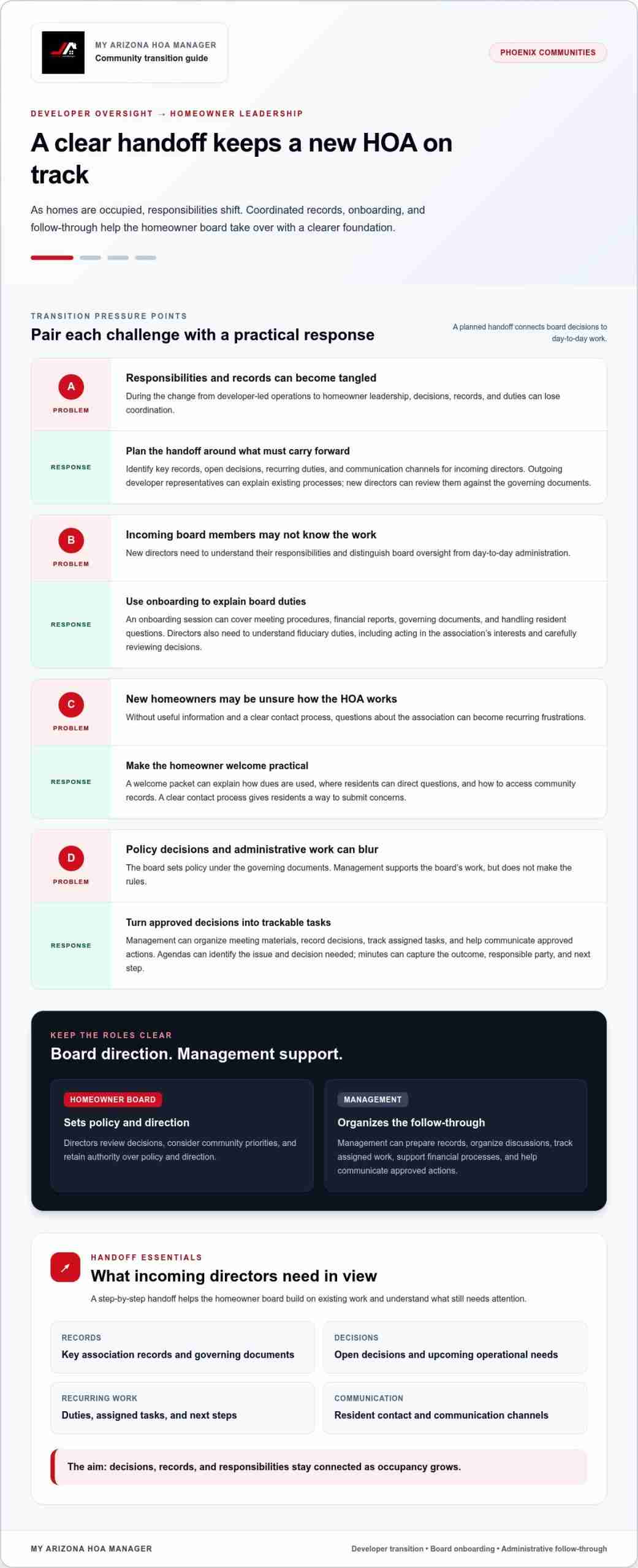
In a new Phoenix community, the developer’s team often serves on the HOA board while few homes are occupied. That arrangement helps establish the association as construction and sales continue. As homeowners move in, the board’s focus gradually shifts toward resident priorities and community operations. A planned handoff helps keep decisions, records, and responsibilities from becoming tangled during that change.
HOA management can support the transition by orienting incoming board members to their responsibilities. An onboarding session, for example, can cover meeting procedures, financial reports, governing documents, and how to handle resident questions. Board members also need to understand their fiduciary duties, including acting in the association’s interests and carefully reviewing decisions. Clear guidance helps volunteers distinguish board oversight from day-to-day administrative work.
At closing, management can welcome new homeowners with practical information about the association. A welcome packet can explain how dues are used, where residents can direct questions, and how to access community records. A clear contact process also gives residents a way to submit concerns. These early steps help homeowners understand the HOA’s role before questions become recurring frustrations.
The board remains responsible for setting policy under the governing documents. An HOA management company supports the board’s work but does not make the rules. For example, directors may discuss a common-area issue, review the relevant documents, and decide on the association’s response. Management can organize meeting materials, record decisions, track assigned tasks, and help communicate approved actions to residents.
Administrative support is most useful when it turns board decisions into trackable work. An agenda can identify the issue, relevant documents, and decision needed. Meeting minutes can record the outcome, responsible party, and next step. When the board approves a resident communication or administrative change, a defined follow-up process helps ensure it reaches the right people.
Strategic support also helps directors look beyond the next meeting. Before setting priorities, the board can review homeowner feedback, community responsibilities, and upcoming operational needs. For instance, directors might separate immediate administrative tasks from longer-term decisions about association procedures. Management can prepare relevant records and organize discussions, while elected board members retain authority over policy and direction.
As occupancy rises, the goal is to involve interested, qualified homeowners in board leadership. A transition plan can identify key records, open decisions, recurring duties, and communication channels for incoming directors. Outgoing developer representatives can explain existing processes, while new board members review them against the governing documents. A step-by-step handoff gives the homeowner board a clearer foundation for managing the association.
What does an HOA management company do?
An HOA management company supports the board with administration, financial processes, and resident communication. New HOA setup services may organize records and workflows. Phoenix communities must also account for applicable Arizona and local requirements.
Basic and High-Performing Service Options
Basic management may focus on routine administration, such as preparing meeting materials, maintaining association records, and responding to resident questions. A broader service may also coordinate financial reporting, budget preparation, maintenance requests, and communication tools. Compare the responsibilities actually covered, not just the service label.
For example, ask how a board decision becomes a tracked task, who prepares financial reports, and how residents submit requests. These details show whether management connects everyday administration with board oversight. An online resident portal can centralize documents and messages, while clear reporting helps directors follow up on open items.
Setup Consultants and Management Companies
Setup consultants generally focus on establishing an association’s initial structure, records, and workflows. Community association management companies typically support ongoing operations after setup, including board administration, financial processes, and resident communication. Services can overlap, so compare each provider’s defined tasks and handoff responsibilities.
To evaluate providers in Phoenix, compare written scopes, sample reports, communication processes, and experience with your type of association. Ask how the provider would organize records, orient directors, and track recurring duties. Focus on practical details: who handles each task, what information reaches the board, and how unresolved items are followed through.
Legal counsel and community management professionals have different roles. Legal counsel can review governing documents and explain how applicable Arizona and local requirements relate to the proposed association structure. A management professional can help turn the board’s approved framework into administrative processes, such as meeting records, resident communications, and financial reporting.
Starting an HOA involves identifying the community’s structure, reviewing its governing documents, and understanding applicable state and local requirements. Considerations can differ for a planned community, condominium association, or amenity association, so clarify the property type and responsibilities before establishing workflows.
Setup commonly includes organizing association records, establishing administrative workflows, preparing board processes, and planning resident communication. For a new condominium association, for example, setup should reflect its governing documents and assigned responsibilities.
Management also affects the consistency residents experience as homes are sold and occupied. The board can use documented procedures for questions, records, and recurring tasks instead of handling each issue differently. Consistent administration helps residents understand how the association operates and supports the builder’s reputation during the transition.
What challenges can occur without a structured setup process?
A new homeowners association begins with decisions about its structure, responsibilities, and governing documents. Without an organized setup, residents may not know which documents guide a decision or who maintains them. For example, a question about a shared amenity can stall if the board can’t locate the relevant rule or identify the association responsible for it. Clear records give directors a reliable starting point.
Developers prepare initial governing documents to establish a framework for managing the community. Those documents guide the association while allowing future boards to make adjustments for residents’ needs. The initial governing body typically establishes HOA rules and regulations during formation. If the board adopts procedures without first reviewing the governing documents, its decisions may conflict with the existing framework.
Document creation works best when each item has a defined purpose and owner. The board can identify the association’s governing documents, record where each approved version is stored, and set a process for updates. For example, if a community has shared amenities, the board should be able to find the documents describing related responsibilities and procedures. Organized records make those details easier to apply consistently.
Common setup pitfalls include:
- Using different versions of a document during board discussions.
- Leaving responsibility for updating records unclear.
- Creating procedures that don’t reflect the initial governing framework.
- Failing to document how the board approved a rule or process.
Each issue can create avoidable confusion. A version-control process, for instance, can mark the current approved document and archive earlier copies. Meeting records can capture board decisions and identify follow-up work.
Document organization also affects relationships with homeowners. If residents receive inconsistent answers about an amenity, they may question whether the same rules apply to everyone. A shared record system helps directors and administrators refer to the same approved materials. Clear filenames, organized folders, and a consistent process for sharing updates make routine questions easier to handle.
Initial documents should support current operations and future leadership changes. A practical handoff file can group governing documents, board decisions, current procedures, and records of open issues. When new directors join, they can review the same materials instead of reconstructing the association’s history from scattered emails. For a growing Phoenix community, this structure helps the board understand what is established and where further decisions are needed.
During setup, boards can use a simple review sequence: locate the governing documents, identify the current approved versions, match procedures to the documents, and record decisions consistently. This doesn’t replace legal review where needed, but it helps prevent administrative gaps from becoming governance disputes. Well-maintained records of rules and decisions give homeowners a clearer basis for understanding how their association operates.
Financial reporting, budgeting, and reserve planning
A startup budget gives board members a financial plan for operating the association as homes are occupied. Regular reports let them compare that plan with actual income and expenses.
Startup Budgets and Initial Reserves
Build the startup budget around the association’s responsibilities, not a generic community template. List expected operating expenses, such as administration, shared-area maintenance, and utilities, then compare them with anticipated income. For example, if an amenity becomes available in stages, account for its operating needs when the association assumes responsibility. Clear categories help members understand what the budget supports.
Initial reserves serve a different purpose from funds for routine operations. They help prepare the association for major infrastructure projects that may need attention every 5-10 years. Identify the community’s assets and likely long-term needs, then show how reserve planning fits alongside operating expenses. A board can review those assumptions as construction, occupancy, and association responsibilities change.
Budget and Dues Setting
To establish dues, the board first needs a complete proposed budget. Add expected operating expenses and planned reserve contributions, then determine how the governing documents allocate assessments among members. Dues should reflect documented community costs, not an unsupported estimate.
For example, if common-area maintenance is an association expense, include it in the budget and explain the allocation method to members. Present the proposed budget with clear categories and supporting assumptions at a board meeting. Directors can then discuss changes before approving the plan, while transparency helps residents understand how dues support operations.
Useful financial reports connect planned spending with actual activity. A report can show income received, expenses paid, and budget categories needing attention. For example, if maintenance spending differs from the forecast, directors can review the invoices and decide whether to adjust future planning. Consistent bookkeeping makes those comparisons easier and gives the board a clearer record for decisions.
Keep operating funds and reserve planning distinct in board materials. This helps prevent routine expenses from obscuring long-term obligations. A community management process can organize financial records, prepare reports, and present budget information for board review. Directors still make the decisions, but structured information helps them compare priorities and document the reasons behind an approved budget.
During each budget review, the board can revisit assumptions about occupancy, services, and shared assets. If a planned amenity is not yet operating, its expected costs may differ from those after residents begin using it. Recording the assumptions behind each budget line helps future directors understand the original plan and update it as community needs develop.
Financial transparency also depends on accessible records. Keep approved budgets, reports, and supporting documents organized so members can follow how association funds are managed. When directors explain a proposed change, they can point to the relevant expense or reserve need. This supports informed discussion without presenting a budget estimate as a fixed cost for every community.
Administrative setup coordination
A new association needs connected workflows, not isolated task lists. A management company can help coordinate records, communication, vendor activity, and recurring administration as development progresses. The board remains responsible for decisions, while clear processes show who handles each follow-up and where its status is recorded.
Start with a responsibility map that names each task, its owner, and its next step. For example, a resident request can move from intake to review, assignment, completion, verification, and closeout. Recording each stage helps board members see whether an issue needs a decision, vendor attention, or resident communication. It also reduces the chance that separate emails become the only record of progress.
Vendor coordination benefits from a consistent administrative process. The association can record the requested work, board approval, assigned vendor, and completion update in one tracking system. For a common-area repair, the record might show when the issue was reported, who reviewed it, and whether the work was verified. This helps directors follow decisions without suggesting that the management company performs construction or repairs.
Development phases add another coordination challenge. Homes may be sold while infrastructure is completed and amenities become available, so association responsibilities can change over time. A responsibility tracker can identify which tasks remain with the developer and which have shifted to the association. Reviewing it at each handoff helps prevent overlooked duties and gives board members a current operational picture.
Centralized records make recurring administration easier to manage. Keep meeting materials, approved decisions, vendor correspondence, and open tasks organized in a shared system. Use consistent file names and status labels, such as “awaiting board decision” or “work completed.” When a director asks for an update, the responsible person can find the latest record instead of reconstructing the history from scattered messages.
Communication workflows should identify the audience and next action. A vendor may need a work request, while residents need an update about access or timing. A simple communication record can capture what was sent, who received it, and whether another update is needed. This keeps board members, residents, and vendors aligned without treating every message as a separate process.
Prepare for leadership changes by maintaining a handoff record of open tasks, recurring administration, vendor contacts, and current workflows. Incoming board members can then see what remains underway and where decisions are needed. A consistent process supports continuity as development progresses and association responsibilities evolve. The practical takeaway is clear task ownership: every request should have a record, a responsible party, and a documented closeout.
For help coordinating association administration and financial workflows, explore HOA management support.
My Arizona HOA Manager: Community Management
My Arizona HOA Manager supports Phoenix associations as they organize community administration and prepare for the transition to homeowner leadership. Its Community Management and Financial Management services help boards coordinate ongoing operations, maintain financial records, and review reporting as responsibilities shift. Online Resident Portals give residents a place to access community information, while Resale Documents support association administration during property transfers.
Consider this support when board members need help organizing administrative and financial processes as a community develops. The board retains responsibility for its decisions, while management helps put approved processes into practice. Contact My Arizona HOA Manager to discuss community management support for your association.
Set the Next Phase of Your Community in Motion
Before the next homes are occupied, give the board a practical transition priority: decide which administrative process needs attention first. It could be organizing incoming records, establishing a clear reporting routine, or preparing residents to contact the association. A defined first step turns new community HOA setup services into a working plan the board can maintain as the community grows.
My Arizona HOA Manager offers Community Management and Financial Management to support association administration and financial processes. Resale Documents also support the paperwork involved when ownership changes. The board can consider which areas need support now and how those needs may shift as the community develops.
For a straightforward next step, share your community’s current stage and the administrative priorities you want to address. Contact My Arizona HOA Manager to discuss support for your Phoenix association. A clear plan can help your community move forward with steady, organized leadership.
Frequently Asked Questions
What services help set up an HOA for a new community?
Setup support can help organize association records, board processes, financial administration, and resident communication. New community HOA setup services can also help prepare a workable handoff from the developer’s team to homeowner leadership. In Phoenix, boards can map responsibilities for each development phase, such as tracking when shared amenities become operational and which association processes should begin as residents move in.
How much does HOA formation and startup cost?
HOA formation and startup costs depend on the community’s structure, governing documents, operating needs, and professional services required. Rather than relying on a generic estimate, outline the work involved, such as document preparation, accounting setup, or administrative support, then gather costs for those specific needs. Keep formation expenses separate from ongoing operating expenses so the board can assess startup needs and recurring commitments distinctly.
What legal steps are required to create an HOA in the United States?
Legal steps depend on the state, community type, and property documents. For a Phoenix development, begin by identifying the proposed association structure and reviewing the developer’s governing documents with qualified legal counsel. The association needs a sitting board at its inception. The board and its advisors can then organize the records and procedures needed to operate under the applicable documents and requirements.
How do you draft HOA governing documents, bylaws, and rules?
Start with the community’s property structure, shared responsibilities, and planned amenities, then have qualified legal counsel prepare or review the documents. The documents should distinguish foundational provisions from board procedures and resident rules. For example, a pool or shared-use space may require clear language about access and responsibilities. Keep approved versions together and record amendments so directors and homeowners can identify the current governing framework.
How do you establish an HOA budget, dues, and reserve fund?
Build the budget from expected operating obligations, then account for long-term infrastructure needs separately. Dues should reflect the association’s documented expenses and the assessment method in its governing documents. For example, list shared utility costs, administration, and planned maintenance before calculating each owner’s share. Present the assumptions to the board and retain the approved budget and supporting records for members to review.
How do you transition HOA control from a developer to homeowners?
Prepare the handoff as a record-based process. Identify current board decisions, open administrative tasks, association records, and responsibilities still handled by the developer. As Phoenix homeowners become involved, incoming directors can review the materials and discuss unresolved items with outgoing representatives. A clear handoff record helps new board members understand the association’s status and prioritize decisions without losing important operational context.
What risks and common mistakes should a new HOA avoid?
A new HOA should avoid scattered records, unclear task ownership, and decisions made without reference to governing documents. Conflicting document versions, for example, can lead board members to apply different procedures to the same issue. Keep a central record of approved materials, decisions, and follow-up tasks. Also distinguish routine operating funds from long-term reserve planning so immediate expenses don’t obscure future infrastructure needs.