
Reliable dues records start with consistent billing, not last-minute cleanup. Outsourced HOA accounting in Surprise, AZ can support assessment billing and payment processing. Associations may collect assessments monthly, quarterly, or annually. Accounting support can also help keep bank reconciliations current and financial records organized for audit preparation.
For board members, these routines make it easier to see what has been billed, what has been paid, and where follow-up may be needed. Accounting involves more than recording deposits: billing schedules, owner accounts, reconciliations, and financial reports need to work together to give the board a useful view of the association’s finances.
This article explains how outsourced accounting supports dues and fee processing, what bank reconciliation involves, and how organized records help prepare an HOA for an audit. It also covers what to consider when deciding whether this approach suits your community in Surprise and nearby areas, and how professional financial management can reduce administrative friction while keeping the board informed.
Key Takeaways
- Match assessment billing to the community’s adopted schedule and keep owner account records current to make follow-up clearer.
- Use regular bank reconciliations to spot differences between association records and bank activity before they build up.
- Organize financial records and supporting documents throughout the year to make audit preparation more manageable.
- Understand how dues and other fees move from billing through payment posting, reporting, and resident communication.
- Consider how bank integration and clear financial reports can help the board review activity and make informed decisions.
Assessment billing and accounts receivable
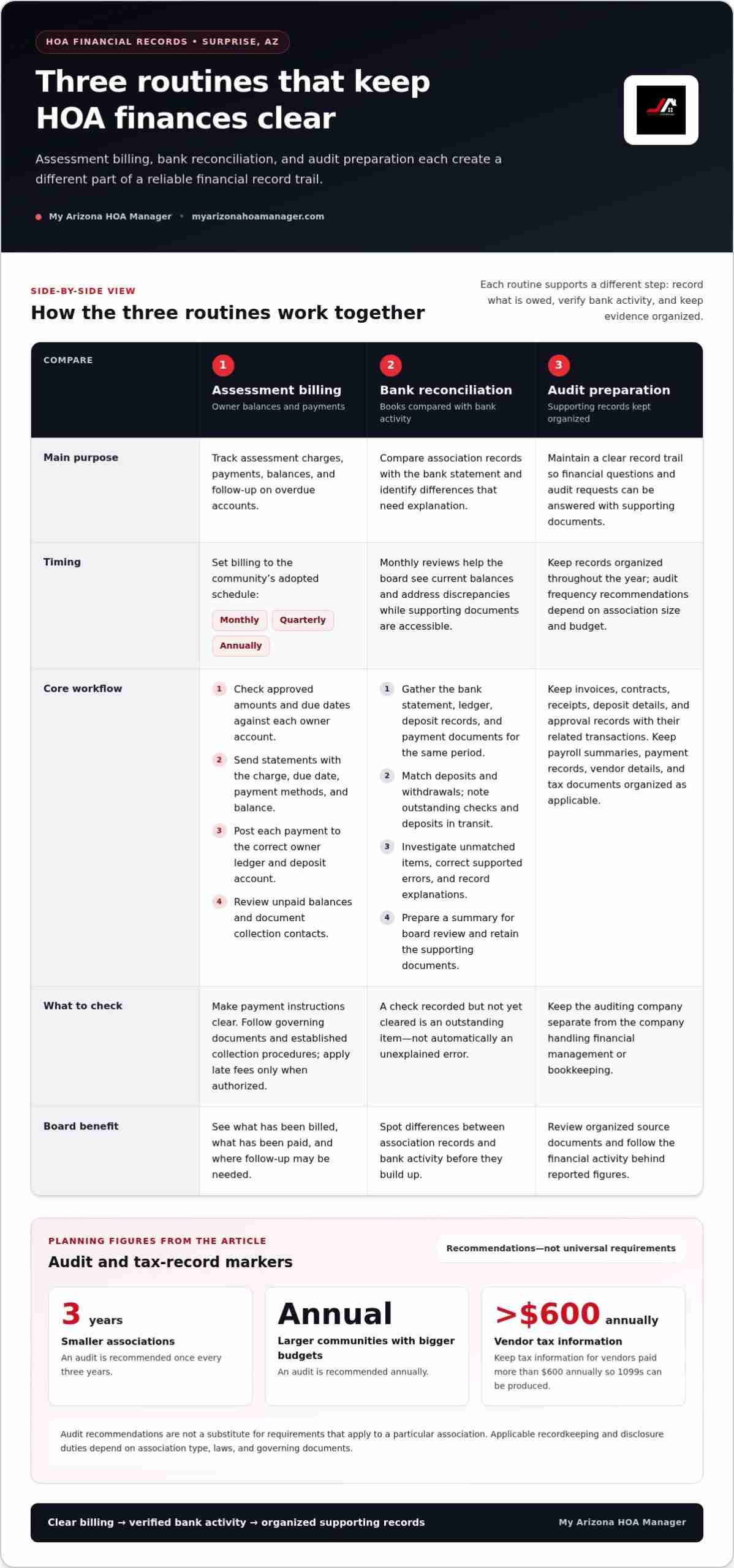
Assessment billing starts with the association’s approved budget, governing documents, and owner ledger. Communities may collect assessments monthly, quarterly, or annually. A clear schedule tells each owner when payment is due, how to pay, and where to direct questions.
Arizona recordkeeping and disclosure duties depend on the association type, applicable laws, and governing documents. Organize ledgers, invoices, bank records, budgets, and approval records, then handle owner record requests according to the requirements that apply.
HOA bookkeeping includes recording assessment charges and payments, tracking expenses, reconciling accounts, and maintaining supporting documents. Financial reports summarize activity for the board, while assessment collection tracks balances, payment status, and follow-up on overdue accounts.
To keep billing accurate, use a repeatable process:
- Compare the approved assessment amount and due dates with each owner’s account.
- Send statements that identify the charge, due date, payment methods, and account balance.
- Post payments to the correct owner ledger and deposit account.
- Review unpaid balances and document each collection contact.
For example, a quarterly charge should appear on the owner statement and ledger for the same period. That consistency helps the board trace a balance without mistaking it for another assessment cycle.
Assessment collection should follow the association’s governing documents and established procedures. If an owner misses a due date, record the unpaid amount, review the account history, and send the required notice before proceeding to the next collection step. Apply late fees only when authorized by the governing documents and applicable requirements. Do not assume or add their amount or timing informally.
Payment instructions should clearly explain the options available to owners. Depending on the association’s arrangements, payment may be made through an online portal, by mailed check, or through another accepted method. Record the date, amount, and credited account in the ledger so each payment can be traced to a specific transaction.
A Surprise board evaluating an accounting provider can review relevant HOA experience, staff qualifications, sample reports, and association references. Ask how assessment payments are posted, overdue accounts are handled, owner questions are answered, and reports are delivered to the board. Compare the answers with your community’s actual workflow.
Before hiring, review the contract’s scope, approval responsibilities, reporting schedule, record access, data security, and termination process. Clarify who authorizes collection notices and late fees, how errors are corrected, and how records transfer when the agreement ends. Clear terms help prevent gaps between billing, bookkeeping, and board oversight.
Bank reconciliation and audit preparation
A bank reconciliation compares the association’s accounting records with its bank statement. Match each deposit and payment to the ledger, then identify timing differences, duplicate entries, and transactions that need explanation. A recorded check that has not cleared, for example, belongs on the list of outstanding items, not among unexplained errors. Monthly reviews help the board see current balances and resolve discrepancies while supporting documents are accessible.
For Surprise HOAs, relevant tax, banking, and community-association requirements depend on the governing documents and applicable rules. Keep statements, transaction records, approvals, and owner disclosures organized so the board can answer financial questions using a clear record trail.
A consistent reconciliation routine can follow these steps:
- Gather the bank statement, ledger, deposit records, and payment documentation for the same period.
- Match deposits and withdrawals, noting outstanding checks and deposits still in transit.
- Investigate unmatched items, correct supported errors, and record explanations.
- Prepare a reconciliation summary for board review and retain its supporting documents.
Audit preparation is easier when records are maintained throughout the year. Keep invoices, contracts, receipts, deposit details, and approval records with their related transactions. Smaller associations are recommended to have an audit once every three years, while larger communities with bigger budgets are recommended to have one annually. These are planning recommendations, not a substitute for requirements that apply to a particular association. The auditing company should be separate from the company handling financial management or bookkeeping.
Tax return preparation support starts with complete records of income, expenses, and vendor payments. The association should keep vendor tax information for vendors paid more than $600 annually so 1099s can be produced. Clear records help distinguish operating activity from other transactions and give the tax preparer organized source documents. Returns rely on accurate entries, so document corrections rather than changing past records without an explanation.
Payroll and tax preparation also rely on a clean transaction trail. Keep payroll summaries, payment records, and related tax documents together, then reconcile payroll payments against the bank statement and ledger. If the association pays vendors, record each vendor’s details and annual payment totals consistently. Organized records help the preparer identify relevant reporting information without confusing vendor expenses with payroll.
Boards seeking help coordinating financial administration with broader community operations can explore community management support.
Keep vendor payment records with the related invoices, tax information, and approvals so reported amounts can be traced to their supporting documents. In Arizona, associations should review their specific governing documents, bylaws, and state statutes to determine whether an annual audit, review, or compilation is required based on their revenue and operational structure. These thresholds can help the board identify the applicable reporting level, while the association should confirm which requirements apply to its circumstances. ClearlyRated says Arizona accountants can help businesses with taxes and specialized services including audit and assurance, business valuation, and consulting. When seeking outside support, clarify the scope of work and retain the engagement documents with the financial records. An organized file helps reviewers trace reported amounts and understand how unusual or corrected transactions were handled.
HOA accounting services in Phoenix and surrounding areas
Outsourced accounting can take recurring financial tasks off volunteer board members’ plates. The right scope depends on which duties the association wants handled and which remain with the board.
Available Accounting Services in Surprise
In Surprise, accounting services may include maintaining financial records, processing dues and fees, handling payroll, preparing tax returns, and managing the association’s budget. Support can also include financial planning and decision-making, giving the board organized information about upcoming expenses and priorities.
Consider the complete workflow, not just the task list. Processing dues, for example, requires recording payments against owner accounts; budget management means comparing actual activity with planned spending. A useful monthly financial report presents figures clearly and explains important trends or issues, helping the board spot where income or expenses differ from expectations.
Reports serve different purposes. A balance sheet shows assets, liabilities, and net worth at a particular point in time. An income statement summarizes revenue and expenses over a period, while a cash flow statement tracks money moving into and out of association accounts. A budget report compares actual results with planned amounts. Together, these reports help members understand financial position, activity, and variances.
HOA financial reports should be prepared by a qualified accountant or financial professional familiar with association requirements. When reviewing accounting services, consider whether the reports answer board questions, preserve a clear transaction trail, and support informed decisions. Boards in Phoenix, Scottsdale, and Tucson, as well as Surprise and nearby communities, can also consider outsourced accounting options.
Accounting Services Versus Full-Service Management
Outsourced accounting focuses on financial work, such as maintaining records, processing dues, reconciling activity, and preparing reports. Full-service HOA management covers a broader range of community administration. The distinction matters: a board seeking help with financial records needs a different scope from one looking for support with wider community operations.
Before choosing a scope, list the tasks board members currently handle and identify where work stalls. If volunteers can manage community matters but need dependable financial statements, accounting support may address the immediate gap. If administrative responsibilities also need coordination, broader management may be a better fit.
Compare proposals by matching each requested task to a clearly defined responsibility. Identify who records transactions, prepares reports, shares financial information with the board, and handles owner account questions. Then decide how the association will review reports and raise discrepancies. Clear assignments prevent duplicated work and show members where to direct routine questions.
Ask how the reporting cycle supports board decisions. Monthly financial reports help directors follow income, expenses, and budget variances instead of relying on scattered records. A well-defined scope also clarifies what the association retains, such as approval authority and oversight. The right fit addresses the board’s actual workload and gives members understandable financial information.
Processing dues and fees
Processing an assessment means applying the correct charge to each owner account, recording payments, and reporting balances consistently. Start with the association’s approved budget and billing schedule, then use them to determine each account’s charge and due date. An annual assessment, for example, should appear as one scheduled charge, not as several monthly entries unless the approved schedule requires them. For boards considering outsourced HOA accounting in Surprise, AZ, accurate posting helps keep account records aligned.
A home purchase adds another step to the payment cycle. At closing, a buyer may have to pay HOA fees, including a one-time initiation fee and ongoing monthly or annual fees. Closing records should identify each charge and the period it covers. Recording these items separately helps distinguish a new-owner charge from regular assessments.
A repeatable processing workflow helps prevent posting errors:
- Confirm the charge, due date, and owner account against association records.
- Record each payment using its received date, amount, and account reference.
- Apply the payment to the intended assessment or fee, rather than leaving it unassigned.
- Compare account balances with deposit and transaction records.
- Document corrections so later reporting shows why an entry changed.
If an owner pays an assessment and an initiation fee together, for example, the ledger should show how the payment was allocated. This helps answer questions about remaining balances and keeps each fee connected to its purpose. A clear payment reference also makes it easier to trace a posting when an owner provides a receipt or asks about a statement.
Financial reports should make dues activity easy for the board and members to understand. They can show assessments billed, payments received, outstanding balances, and other fee income for the reporting period. Comparing those totals with the budget helps directors see whether collections align with planned income. If a total changes after a correction, the supporting entry should explain the adjustment.
Consistent reporting also makes follow-up more useful. The board can review unpaid accounts, compare them with recent payments, and direct the next collection step according to association procedures. Keep notices and account notes with the relevant records so later questions about a balance can be answered from the account history, not memory.
For an HOA seeking outsourced HOA accounting in Surprise, AZ, the practical test is whether each charge can be traced from its approval to the owner ledger and financial reports. Clear categories, accurate payment allocation, and documented corrections help members understand how association income is recorded. They also give directors a more useful view of dues activity when reviewing the budget and planning community expenses.
Bank integration and reconciliations
Bank integration connects an association’s accounting records with its bank activity. Real-time integration provides immediate visibility into cleared transactions, helping treasurers identify deposits and withdrawals as they post. It does not replace reconciliation: accounting records still need to be compared with the bank statement and supporting documents.
For a Surprise HOA, start by defining which accounts and transactions the board needs to review. A practical process separates cleared transactions from pending items, then matches each cleared deposit or payment to its ledger entry. An assessment deposit, for example, should match the recorded amount and deposit date. Explain unmatched transactions before finalizing financial reports.
Use a consistent review sequence:
- Review the bank feed for cleared transactions and compare them with ledger entries.
- Match deposits, checks, and electronic payments to supporting records.
- Set aside pending items, such as a check that hasn’t cleared.
- Investigate duplicates, missing entries, or amounts that don’t match.
- Record any correction with its reason and supporting document.
Clear responsibilities help make integration useful. When practical, assign one person to review imported activity and another board member to examine reconciliation summaries. Each association payment should be traceable to an invoice or approval record. This separation gives the board a clearer review trail without treating an automated bank feed as approval.
Homeowners may ask why a ledger balance differs from a bank balance. A brief explanation can identify a timing difference, such as a deposit recorded before it clears the bank, or a payment that remains outstanding. Keep the statement, transaction details, and reconciliation notes together so the board can answer questions from documents instead of reconstructing events from memory.
Bank integration can also support reporting during the board’s regular financial review. A treasurer can use cleared transactions to investigate unexpected spending, confirm deposits, and flag entries that need documentation. The board should still review complete financial reports: a bank feed alone does not explain budgets, liabilities, or the purpose of each transaction.
For an HOA home purchase, financial statements and other association records form part of the information provided to a buyer. Keeping statements and transaction records organized can make it easier to assemble accurate resale documents. For help with the association’s resale documentation, review resale document support.
My Arizona HOA Manager: Community Management
My Arizona HOA Manager provides community management and financial management for associations that need support with day-to-day administration and HOA finances. If your board wants to organize financial workflows alongside broader community responsibilities, these services offer a practical next step.
Online resident portals give communities a way to provide residents with access to information, while resale documents support association records during property transactions. Consider which responsibilities need support, from financial administration to resident-facing resources, and choose services that fit your community’s needs.
If your association is ready to discuss its management needs, contact My Arizona HOA Manager.
Set a Clear Direction for Your HOA’s Finances
Turn your accounting needs into a practical plan by identifying which financial responsibilities the board wants support with, who will review decisions, and how financial information should reach homeowners. A shared understanding of these roles gives the association a clear starting point for discussing its management needs.
My Arizona HOA Manager offers Financial Management and Community Management, with Resale Documents to support association records during property transactions. These services can be part of a broader conversation about how financial administration fits into your community’s operations. For an association considering outsourced HOA accounting in Surprise, AZ, defining the board’s priorities first can make that conversation more focused.
Contact My Arizona HOA Manager to discuss your association’s needs. A thoughtful next step can help your board move forward with greater clarity and confidence.
Frequently Asked Questions
Which HOA accounting companies serve Surprise and the Phoenix West Valley?
My Arizona HOA Manager serves Surprise and nearby West Valley communities, including Peoria, Glendale, Avondale, Goodyear, and Litchfield Park. Its Financial Management services support HOA accounting needs, while Community Management addresses broader association administration. First define whether your board needs help with financial work alone or with wider community management. That distinction helps clarify the scope before discussing a management arrangement.
What accounting software and online payment options do HOA providers offer?
Software and payment methods vary, so boards should focus on how a system supports their workflow. My Arizona HOA Manager offers Online Resident Portals as an online channel for community operations. When evaluating software, consider owner account access, clear transaction records, and reports that board members can understand. Also consider whether homeowners receive a clear receipt or account reference to help resolve posting questions.
How do HOAs transition financial records and banking to an outsourced accounting provider?
Set a transition date and create a handoff inventory covering account balances, owner ledgers, outstanding payments, vendor records, and current financial documents. Identify open items, such as an invoice awaiting approval, so the next workflow can address them without confusion. Then establish authorized banking access through the association’s chosen process, test transaction visibility, and compare opening balances with source statements before routine reporting begins.
What Arizona laws and requirements apply to HOA financial records and disclosures?
Arizona recordkeeping and disclosure duties depend on the association type, applicable requirements, and governing documents. Keep ledgers, invoices, bank records, budgets, and approval records organized, and handle owner record requests according to the requirements that apply.