
The best fit isn’t necessarily the management company with the longest service list. For community association management in Chandler, prioritize clear financial reporting, a dependable process for maintenance requests, and consistent support with violations and compliance. A manager should also communicate clearly with the board and residents so responsibilities and next steps stay visible.
Boards need steady support without losing visibility into how their community is run. This guide explains what to look for when comparing managers, how to assess financial reporting and maintenance coordination, and what effective support with violations and compliance can involve.
You’ll also learn how management arrangements work, what can affect costs, and how to decide whether a management partner fits your association’s needs. The goal is a practical way to compare options and bring greater clarity to community operations.
Key Takeaways
- Compare managers by how clearly they explain financial reporting, assessment collection, and board responsibilities.
- Look for dashboards that make budgets, transactions, and outstanding assessments easier to review and discuss.
- Assess a manager’s experience by how they communicate through homeowner conflicts and apply community rules consistently.
- Clarify how maintenance concerns are documented, prioritized, and followed through for common areas.
- Understand the steps for inspections and covenant enforcement so residents receive clear, consistent communication.
What should I look for in a management company?
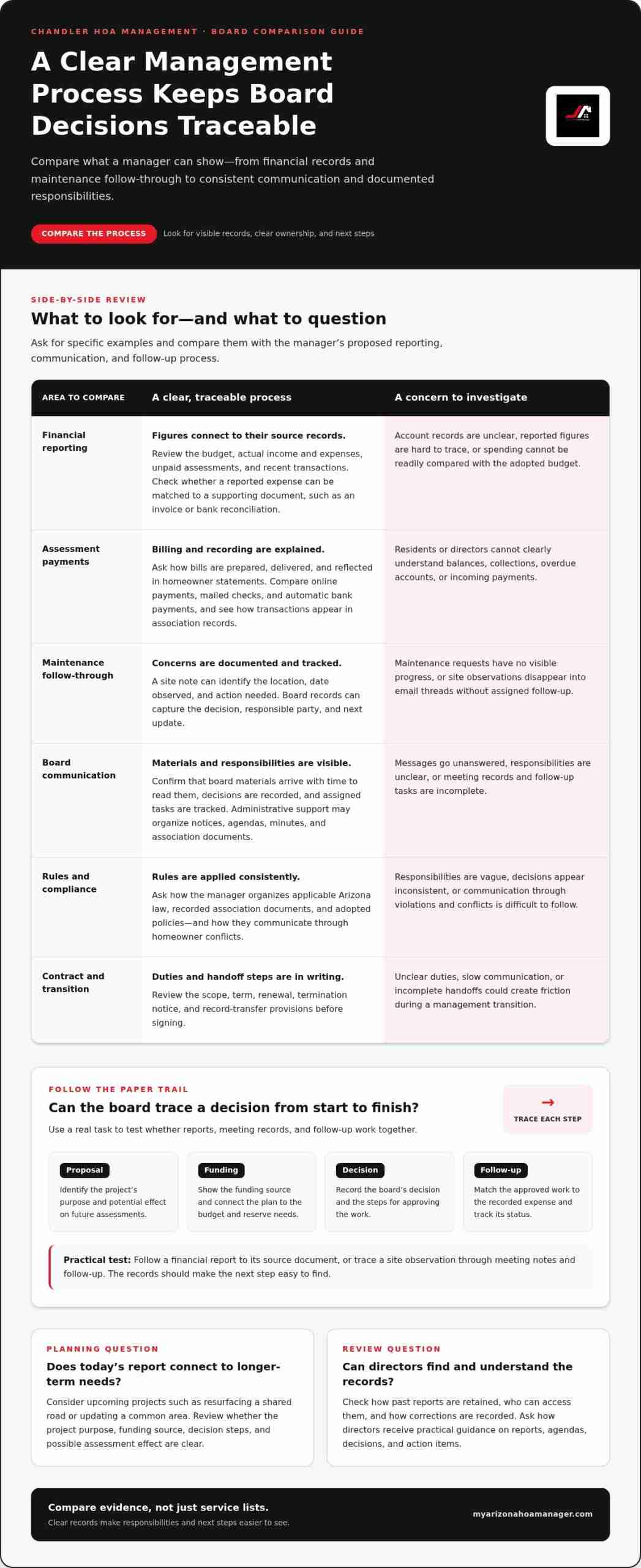
Compare how each manager handles financial records, assessment payments, community planning, and board communication. In Chandler and other Arizona communities, clear responsibilities and organized documents help boards make decisions and explain them to homeowners.
Start with the association’s current budget, reserve plan, and upcoming projects. Ask how the manager connects routine financial reporting with longer-term needs, such as resurfacing a shared road or updating a common area. A useful planning process identifies the project’s purpose, funding source, decision steps, and potential effect on future assessments.
For an upgrade, the board should be able to trace the decision from initial proposal to approved work and recorded expense. Review meeting materials alongside financial statements to see whether spending matches the adopted budget and whether the reason for an assessment change is documented.
Assessment Billing, Statements, and Payment Methods
Ask how assessment bills are prepared, delivered, recorded, and reflected in homeowner account statements. Compare payment options, such as online payments, mailed checks, or automatic bank payments, and see how each transaction appears in the association’s records. A clear process helps residents understand their balances and gives the board a practical way to track collections, overdue accounts, and incoming payments.
Company Reviews, Ratings, and Management Risks
Which Chandler HOA management companies have the best reviews and ratings? There isn’t one best fit for every board. Compare recent Chandler-area feedback for recurring comments about financial accuracy, communication, and follow-through. Watch for complaints about unanswered messages, unclear account records, or maintenance requests without visible progress. Look for specific examples, then compare them with the manager’s proposed reporting and escalation process.
Arizona HOA Rules and Management Contracts
What Arizona laws and rules apply to HOA and community association management? Management work should follow applicable Arizona law, the association’s recorded documents, and its adopted policies. Ask how the manager organizes these documents and supports consistent board decisions. What should Chandler HOA boards know about management contracts and termination? Review the scope, term, renewal, termination notice, and record-transfer provisions before signing. What are common risks and complaints involving HOA management companies in Chandler? Unclear duties, slow communication, and incomplete handoffs can cause friction, so put responsibilities and transition steps in writing.
Board technology and financial dashboards
Useful board technology turns financial records and community tasks into information directors can act on. Evaluate the dashboard, meeting preparation, site updates, and administrative support as connected parts of one process.
Consider a familiar example: a board member opens the monthly financial dashboard before a meeting. They should be able to find the current budget, actual income and expenses, unpaid assessments, and recent transactions. A clear layout helps the board spot questions early, such as an expense that differs from the approved budget or an assessment balance that needs follow-up.
Ask how reports are organized and whether supporting documents are easy to find. A useful dashboard links summary figures to underlying records, such as an invoice, bank reconciliation, or meeting decision. Board members can then trace a figure rather than rely on a standalone total. Check how past reports are retained, who can access them, and how corrections are recorded.
- Review whether the dashboard separates income, expenses, and outstanding balances.
- Check that each reported expense can be matched to a supporting document.
- Confirm board materials arrive with enough time for members to read them.
- Identify who records decisions and tracks assigned follow-up tasks.
- Look for a clear way to report and monitor common-area concerns.
Technology works best when board members know how to use it. Ask for practical guidance on reading financial reports, preparing an agenda, recording decisions, and tracking action items. After approving a repair, for example, the board record should capture the decision, responsible party, and next update. This makes later review easier.
Site inspections and board meetings should connect to the same recordkeeping process. A site note about a damaged gate, for example, can identify its location, the date observed, and the action needed. At a meeting, board members can review the open item, assign follow-up, and document its status, keeping observations from disappearing into email threads.
Administrative support includes organizing notices, agendas, minutes, and association documents. For an annual meeting, the board can map the preparation steps: assemble materials, distribute notices, record attendance, and preserve approved minutes. Clear ownership of each task helps prevent missing paperwork and gives residents a consistent record of association decisions.
Before selecting a management approach, walk through a real board task from start to finish. Follow a financial report to its source document, or trace a site observation through meeting notes and follow-up. This practical exercise shows whether the technology supports the board’s actual work.
Are your community managers certified or experienced in HOA management?
Experience matters most when a manager can turn community rules into clear, even-handed action. Carla Helmstadter, AAM’s Regional Vice President, has more than 27 years of community management experience and is a Certified Arizona Association Manager through the Arizona Association of Community Managers. For any prospective manager, ask how training and hands-on experience inform homeowner communication, conflict response, and rule enforcement.
Ask how the manager has handled difficult situations, such as a disagreement about parking or a repeated noise complaint. A useful response explains how they record the concern, review the governing documents, communicate with the parties, and report the issue to the board when needed. This helps show whether the manager can remain neutral when a neighbor dispute becomes personal.
Consistency matters as much as tone. If two homeowners receive different responses to similar concerns, trust can erode quickly. Ask how the manager tracks correspondence and prior actions and helps the board apply its policies consistently. Dated records of notices, resident replies, and board direction give everyone a clearer account of what happened.
Homeowners should have a straightforward way to raise questions and report community issues. How can Chandler homeowners contact their HOA management company or report an issue? Use the contact details in the association’s current notices or resident portal, and include the location, a concise description, and relevant photos when reporting a common-area concern. Keeping a copy of the message makes follow-up easier.
A resident portal can organize association communication, but boards should assess its actual functions rather than assume every portal works the same way. Check whether homeowners can find community documents, submit questions, and review announcements. Ask how messages reach the management team and how residents can tell whether a request was received or needs more information.
Mobile access can simplify routine tasks for homeowners who prefer a phone to a computer. Review the portal on a mobile screen and see whether key documents and contact options are easy to find. A resident looking for meeting information or an association insurance document, for example, should be able to locate the right resource without searching through unrelated notices.
Before choosing a management approach, test a real communication path. Submit a sample question, follow it to the responsible person, and note how the response is recorded. This helps board members assess resident support, portal usefulness, and the manager’s approach to everyday conflicts.
Common-area maintenance and building management
A practical maintenance process connects inspections, reserve planning, and vendor follow-through. Chandler boards can assess how a management company turns a reported issue into documented work and a clear update.
Reserve Studies and Maintenance Planning
A reserve study helps a board plan for major shared assets, such as roofs, pool equipment, private streets, or entry gates. Review whether the plan identifies each component, its condition, expected future work, and funding approach. These details help directors weigh long-term needs against current priorities.
Connect the study to the community’s maintenance calendar and financial planning. If a pool surface appears worn, for example, the board can review its condition, likely timing, and available reserve funds before deciding on a project. In the Phoenix area, boards should also consider how local heat affects exposed materials and equipment.
Ask how often planning records are reviewed and who presents updates to the board. A useful update identifies changes, explains their significance, and records the board’s next decision. This keeps future work visible instead of buried in an old report.
Inspections and Maintenance Coordination
Common-area inspections give boards a consistent view of shared property. Inspection notes should identify the location, observed condition, and recommended next step. A note about a loose pool gate latch, for example, is more useful when it says where the issue was found and whether follow-up is pending.
Ask how inspection findings become tracked work items. A clear process records the report, assigns responsibility, and updates the board when the status changes. Residents can also report concerns, while regular inspections help capture issues they may not encounter in their daily routines.
Boards can review open items at regular meetings and distinguish urgent concerns from routine upkeep. Written records should make it easy to see what was reported, what action followed, and whether another visit or repair is still needed.
Vendor Coordination for Maintenance
Vendor coordination starts with a defined scope. For a damaged walkway, the board should know which area needs attention, what work is proposed, and how completion will be reviewed. A management company can organize communication and status updates, while the board retains responsibility for setting priorities and approving decisions.
Before work begins, keep the proposal, board direction, and relevant correspondence together. During the job, record schedule changes or questions that affect the scope. Afterward, document the completed work and any remaining items, such as debris removal or a follow-up visit.
This paper trail helps boards compare the original request with the result and address incomplete work promptly. It also gives future directors a useful record if the same building component needs attention again.
Do you help with violations and compliance enforcement?
Consistent enforcement starts with clear records and the association’s governing documents. Boards should understand how inspections, notices, homeowner responses, and follow-up fit together.
Compliance Inspections and Covenant Enforcement
A compliance inspection compares observable property conditions with the community’s CC&Rs and adopted standards. A useful record identifies the location, observed condition, relevant rule, and date, such as a vehicle parked in a restricted area. Ask how the management company distinguishes a documented violation from a concern that needs clarification before contacting a homeowner.
City requirements and association covenants serve different purposes. City rules address municipal matters, while the association applies its governing documents to community issues. Boards should use the documents that apply to the property and keep inspection notes specific, factual, and respectful.
CC&R Violation Management
A clear violation process gives the homeowner enough information to understand the concern and respond. For example, a notice about an exterior change should describe the observed alteration and identify the relevant approval process. The manager can organize correspondence and present the matter for board direction, while the board applies its governing documents consistently.
Communication should remain neutral, even when a homeowner disagrees. Record the resident’s response, any supporting documents, and the next action. If the issue is resolved, update the file. If it continues, follow the association’s established steps rather than improvising a different response for that household.
Compliance Tracking
A tracking record helps board members see each case’s status without relying on scattered emails. Useful fields include the property location, inspection observation, notice date, homeowner response, board direction, and resolution. This chronology distinguishes open matters from resolved ones and supports consistent follow-through across neighborhoods.
Review the tracking process during board meetings. Summarize open cases by status, for example, and flag items awaiting a homeowner response or board decision. Limit reports to information needed for association business and store records with appropriate access controls. Organized files also help maintain continuity when board membership changes.
Before adopting an enforcement workflow, map its steps against the CC&Rs and the board’s written policies. Decide who documents inspections, who approves notices, how responses are recorded, and how closure is logged. Consistent steps help boards address violations fairly and explain the process to homeowners.
My Arizona HOA Manager: Community Management
My Arizona HOA Manager helps associations organize community operations, financial records, and resident information. If your Chandler board needs steady support with association administration, Community Management can help coordinate responsibilities and communication.
Financial Management supports bookkeeping, accounting, and financial reporting, giving board members a clearer view of association activity. Online Resident Portals give residents a central place to access community information, while Resale Documents support transactions that require association records. Together, these services address practical administrative needs while leaving governance decisions with the board.
If your association is reviewing its management needs or wants more organized financial and resident support, contact My Arizona HOA Manager to discuss your community.
Set Your HOA Up for Steadier Decisions
A management decision can shape how confidently your board handles its work long after a contract begins. Before taking the next step, agree on your community’s priorities and use them to guide the conversation. Some boards need clearer financial oversight; others prioritize dependable administrative support or organized association records.
My Arizona HOA Manager offers Community Management, Financial Management, and Resale Documents. These services support boards seeking help with community operations, association finances, or records needed for a resale. Start with your association’s priorities and the support you want in place.
If you’re considering community association management in Chandler, bring your board’s goals and questions into the discussion. Contact My Arizona HOA Manager to explore a practical next step for your HOA.
Clear priorities can help your board move forward with greater confidence and a more organized plan.
Frequently Asked Questions
How much does HOA management cost in the East Valley?
HOA management pricing depends on the community’s needs and the work covered by the agreement. Factors can include association size, requested administrative and financial support, litigation, reserve levels, and major projects. Pricing is provided through a quote request. For an apples-to-apples comparison, outline the same expected duties and project needs when requesting proposals.
What’s included in HOA management services in Chandler, AZ?
HOA management may combine community administration with financial and resident support. A board preparing its annual budget, for example, may need bookkeeping and financial reporting, while residents may need online access to association information. Resale documents can support transactions involving homes in the community. The scope depends on the agreement, so match requested tasks to clearly described responsibilities.
What community association management companies serve Chandler, Arizona?
My Arizona HOA Manager provides community management for homeowner associations in Chandler and across Arizona communities, including Scottsdale, Phoenix, Mesa, Tucson, Glendale, Chandler, Avondale, Litchfield Park, Maricopa, Goodyear, Surprise, Peoria, Tempe, Fountain Hills, Cave Creek, and Anthem. Boards can start by identifying priorities such as financial administration, resident access to records, or coordinated association operations. Compare the proposed scope and reporting approach with those priorities to assess fit.
What services do community association management companies provide in Chandler?
Community management can include financial management, bookkeeping, accounting, online resident portals, and resale documents. The services offered depend on the provider and agreement. An association organizing financial records may prioritize accounting support, while one focused on resident access may value an online portal. HOA management does not necessarily include direct landscaping or construction work, so distinguish management oversight from performing that work.
How much do HOA management services cost in Chandler, Arizona?
There isn’t one fixed cost for every Chandler association. Pricing depends on the community’s needs, the scope of management, and factors such as litigation, reserve levels, or major projects. Request a quote for pricing specific to your association. To make proposals easier to compare, describe your community’s needs and ask each provider to define the work covered.
How do I choose and hire a community association management company in Chandler?
Start by agreeing on the board’s priorities, then prepare a written scope covering the responsibilities it wants managed. Compare proposed services, reporting, communication practices, and contract terms against that scope. Before signing, make sure the agreement explains the work, term, renewal, termination process, and transfer of association records. For community association management in Chandler, a focused proposal makes it easier to identify a suitable fit.
Which Chandler HOA management companies have the best reviews and ratings?
There isn’t one best fit for every board. Compare recent Chandler-area feedback for recurring comments about financial accuracy, communication, and follow-through, then check specific examples against the manager’s reporting and escalation process.