
What if the best way to collect overdue HOA dues is to make the process more predictable, not more forceful? Unpaid assessments can strain cash flow and complicate budget planning, while repeated follow-up can take time away from volunteer board members. A consistent approach to HOA dues collection services can help address both challenges without making every reminder feel like a confrontation.
Arizona boards need clear records, respectful communication, and steady oversight to keep assessment follow-up fair and organized. Set a documented process, track account status accurately, and handle similar situations consistently. When questions or delays arise, a calm, straightforward approach can reduce friction and support better financial decisions.
This guide covers practical steps for monitoring receivables, communicating about overdue balances, maintaining useful financial records, and deciding when an account needs further attention. It also explains how coordinated community and financial management can support this work, helping boards oversee association finances while preserving homeowner relationships.
Key Takeaways
- Map each stage of assessment follow-up, keeping routine reminders separate from formal notices and escalation.
- Compare board-led follow-up, community-management support, and third-party involvement to clarify responsibilities and oversight.
- Use HOA dues collection services as part of an organized financial process, with accurate receivables records supporting clearer reporting.
- Build a board checklist for account reconciliation, communication records, approvals, and regular review.
- For legal questions, consult current Arizona statutes, the association’s governing documents, and qualified counsel.
Why Consistent HOA Dues Collection Matters to Arizona Communities
HOA dues collection involves tracking assessments, communicating with homeowners about balances, recording payments and follow-up, and resolving overdue accounts. It is part of responsible financial administration, not simply a matter of sending reminders. Homeowner associations fund shared responsibilities through assessments, and the Homeowner association overview explains their role in governing communities and collecting dues. An Arizona board should base its process on the association’s governing documents and the current laws that apply to its community.
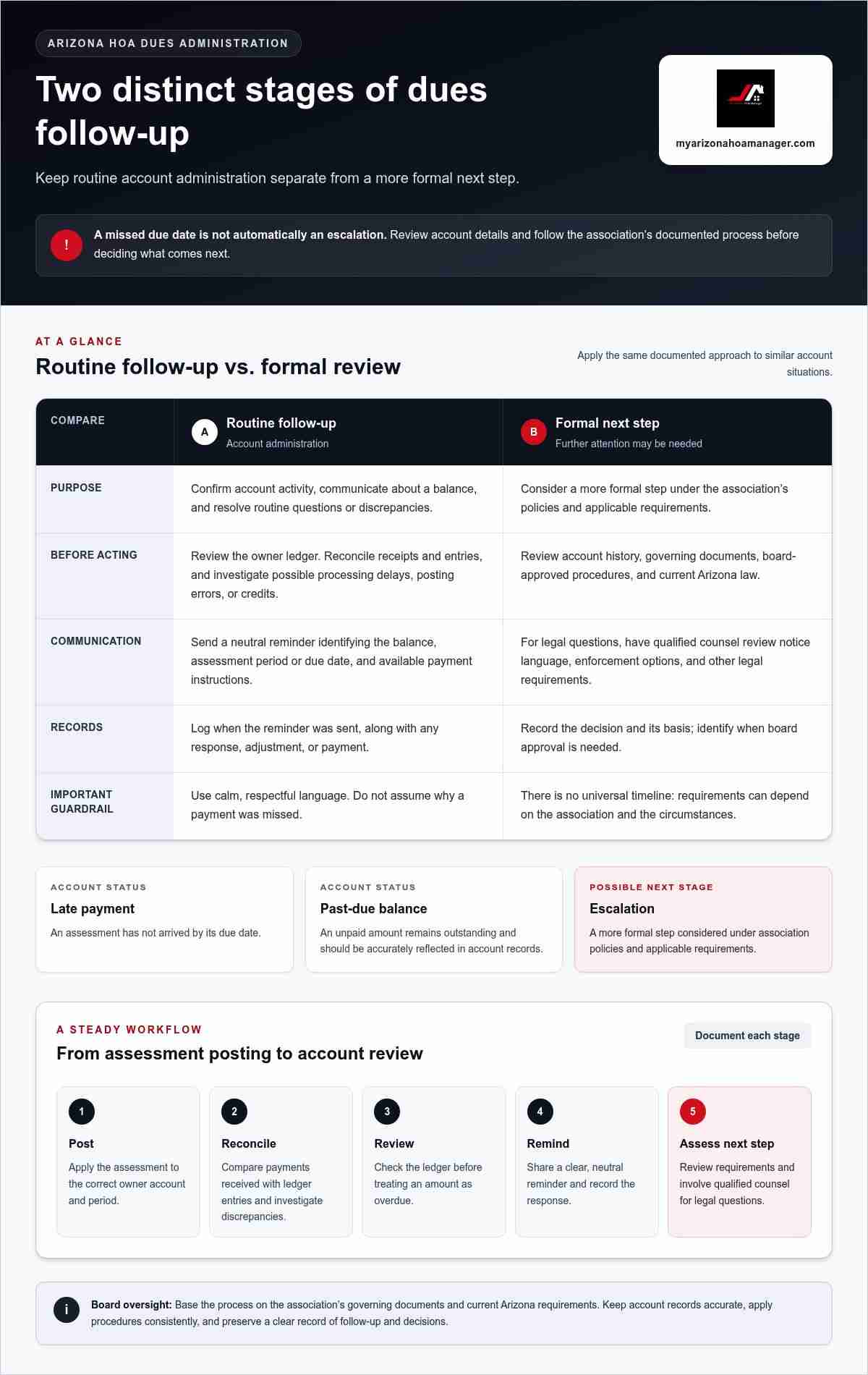
Clear stages help boards respond proportionately. A late payment has not arrived by its due date. A past-due balance is an unpaid amount that remains outstanding and should be accurately reflected in account records. An account requiring escalation has reached a point where the association considers a more formal step under its policies and applicable requirements. These terms are not interchangeable, and one missed due date does not mean every account should receive the same response.
Informal, account-by-account decisions can lead to uneven treatment and incomplete records. A board-approved process gives volunteers a shared reference for what to track, how to communicate, and when to review an account. Check the details against current Arizona law and the community’s governing documents, since requirements can depend on the association and the situation.
How overdue assessments affect an HOA budget
When expected assessments are not received, the association may have less cash available than its budget assumes. That gap can affect the timing of operating expenses, reserve contributions, and planned maintenance. It does not automatically mean work must be delayed, but it can make financial decisions harder if board members do not know which balances are outstanding or how long they have remained unpaid.
For example, a community may budget for routine common-area upkeep based on expected assessment income. If payments are missing, an accurate receivables report helps the board distinguish a temporary timing gap from a broader collection concern. Reliable tracking connects account activity to financial reporting, giving directors a clearer basis for reviewing cash flow and making adjustments.
Why a consistent process supports residents and boards
Homeowners should receive clear, respectful communication that explains the balance and next step without assuming why a payment was missed. A record of notices and responses also helps board members maintain consistent follow-up when volunteer roles change. A documented dues collection process is a written, consistently applied record of how the association tracks, communicates about, and addresses overdue assessments.
Calm communication can prevent misunderstandings, such as a payment not yet reflected in the account or a homeowner who needs clarification. HOA dues collection services can be part of coordinated community and financial management, where organized receivables support useful reporting and board oversight. The goal is steady administration: treat similar situations consistently, keep reliable records, and leave room for respectful problem-solving.
How an HOA Dues Collection Process Works, Step by Step
A dependable process starts with accurate account information and moves through defined stages instead of jumping from a missed payment straight to enforcement. The board should establish procedures that fit the governing documents and applicable Arizona law, then apply them consistently. Community and financial management can support the administrative workflow, while the board maintains oversight of decisions.
From assessment posting to early homeowner communication
Post assessments to each owner’s ledger according to the association’s approved schedule. Record payments when received and reconcile account activity so a processing delay, posting error, or credit is not mistaken for an unpaid balance. If an amount appears overdue, review the ledger before contacting the homeowner.
A routine reminder should be neutral and useful: identify the balance, the assessment period or due date, and the available payment instructions. Log when it was sent and record any response, adjustment, or payment. The Community Associations Institute (CAI) offers broader community-association resources that can help boards build their understanding of sound governance and management practices.
When an account may need a more formal next step
A routine reminder is not the same as a formal notice or collection action. Before moving to a more formal stage, review the account history, governing documents, board-approved procedures, and requirements under current Arizona law. Do not treat one timeline as universal, since requirements can depend on the association and circumstances.
Ask qualified legal counsel to review questions about notice language, enforcement options, and other legal requirements. This helps the board distinguish an administrative follow-up decision from a legal step and identify when board approval is needed. Keep the decision and its basis in the association’s records.
- Post the assessment. Apply the charge to the correct owner account and assessment period, using the association’s established schedule.
- Track and reconcile payments. Compare receipts with ledger entries and investigate discrepancies before treating a balance as overdue.
- Send a routine reminder. Share clear account information and payment instructions in a neutral tone; record the date and communication method.
- Review the account. Consider the full ledger, homeowner response, payment activity, and any adjustments. Correct errors before deciding what comes next.
- Consider formal action only when appropriate. Follow governing documents and applicable law, obtain required board direction, and involve counsel for legal questions or review.
Every account action should leave a clear record of what happened, when it happened, and why the next step was taken. That record helps directors understand the account history, supports continuity when board roles change, and makes it easier to explain the process respectfully. A dated ledger note or saved copy of a communication is more useful than relying on memory or informal conversations.
For boards coordinating assessment follow-up with bookkeeping and financial reporting, community and financial management support can bring these administrative steps into a broader operating process.
In-House Follow-Up, Management Support, and Collection Agencies Compared
Boards can organize overdue-account follow-up in different ways. Directors may handle it themselves, delegate administrative coordination to a community management team, or involve a third-party collection agency for certain accounts. The right fit depends on the association’s workload, procedures, and governing documents. Comparing roles helps a board decide where support is useful while maintaining oversight.
| Approach | Responsibilities | Records and communication | Oversight and escalation |
|---|---|---|---|
| Board-led | Directors or designated volunteers review accounts and handle follow-up. | Board members maintain or coordinate ledger notes and homeowner communications. | The board has direct visibility, but follow-up can depend on volunteer time and consistent handoffs. |
| Management support | A management team can coordinate administrative steps and connect receivables with bookkeeping and financial reporting. | Account activity and communications can be organized alongside other association records. | The board retains oversight and makes decisions assigned to it by governing documents and policy. |
| Collection agency | A third party may be engaged for defined collection work under the association’s process. | The association should establish how account status and communications are reported back. | The board needs visibility into activity and should confirm how further steps are authorized. |
What boards retain when they delegate administrative work
Delegation can shift routine coordination, but it does not erase governance. The board still needs a clear view of outstanding balances, actions taken, unresolved questions, and decisions requiring its attention. Responsibilities reserved to directors depend on the governing documents and the association’s approved procedures. Legal interpretations and enforcement questions may require qualified counsel, rather than an administrative assumption.
Before dividing the work, define who updates records, who communicates with homeowners, how issues are referred to the board, and what reporting directors receive. This prevents gaps where each party assumes someone else is monitoring an account.
How to assess cost structure and community impact
Support arrangements can have different fee structures. Costs may be paid by the association, calculated on a contingency basis, or assessed to a homeowner where permitted. The board should understand how a proposed structure works, how charges are recorded, and what the governing documents and applicable law allow. Do not assume a fee can be added to an account simply because a third party charges it.
Unclear fee allocation can prompt disputes and weaken trust. Set out the process in board-approved procedures, communicate account information respectfully, and review reports for financial activity and unresolved concerns. Dues follow-up should fit the association’s broader financial administration, not operate beyond board visibility. A consistent management approach can connect follow-up with accurate accounting while leaving governance decisions where they belong.
An Arizona HOA Board Checklist for Fair, Well-Documented Follow-Up
A reliable checklist gives directors a practical pause point before an overdue account moves to a more formal stage. It helps the board confirm that account information is accurate, communications are documented, and decisions follow the association’s procedures. The checklist supports consistent administration, but does not replace a review of current law or the community’s governing documents.
Records and controls to review before escalation
Start with the account. Compare the owner ledger with payment records and the approved assessment schedule. Check for payments awaiting posting, credits, or adjustments that could change the balance. This reconciliation can prevent follow-up based on incomplete or outdated information.
Before approving a next step, make sure the relevant records are together. An organized file lets directors or authorized management staff understand what has happened without relying on memory or scattered emails.
- Account records: Confirm the owner, assessment period, posted charges, payments, credits, and current balance.
- Communication history: Keep copies of reminders or notices, dates sent, delivery information, and homeowner responses.
- Board oversight: Record relevant approvals, meeting decisions, and the reason for any action that requires board direction.
- Account adjustments: Document corrections and retain enough detail to explain what changed and why.
- Information access: Limit access to sensitive financial and homeowner information to people authorized to handle association business.
Good bookkeeping connects account-level activity with useful financial reports. For related compliance context, consult this Arizona HOA financial compliance guide. Broader Arizona HOA financial management guidance can also help boards understand how receivables fit into association accounting.
Arizona-specific legal and governing-document checkpoints
Before stating what a board must do, identify which requirements apply to the association and situation. Review the relevant Arizona Revised Statutes alongside the declaration, bylaws, and other governing documents. Do not treat another community’s procedure or a timeline remembered from a past matter as a statewide rule.
Questions about notice requirements, fees, liens, or enforcement deserve careful review. Requirements can depend on the type of association, the governing documents, and current law. Qualified legal counsel can help interpret those requirements and review proposed notices or enforcement steps. Financial management can organize association records, but it does not substitute for legal advice or board oversight.
Use the checklist as a recurring control, not just a last-minute review. Assign responsibility for recordkeeping, decide how unresolved questions reach the board, and revisit the process when governing documents or applicable requirements change. For coordinated association financial management support, My Arizona HOA Manager brings accounting, bookkeeping, and financial reporting into the broader community-management process.
How Community and Financial Management Can Support HOA Dues Administration
Dues administration works best as part of the association’s broader financial operations, rather than as a separate follow-up task. Assessment records affect bookkeeping, accounting, and financial reports, while community management connects those records with board procedures and homeowner communication. This coordinated view gives directors clearer visibility into account activity and the association’s overall finances.
Connecting dues tracking with financial reporting
Each assessment and payment recorded in an owner’s account contributes to the association’s receivables picture. Bookkeeping keeps transactions organized, while accounting helps ensure balances are reflected appropriately in the association’s financial records. Financial reporting gives the board a way to review outstanding receivables alongside other information used to guide community operations.
For example, a board reviewing a financial report can see whether unpaid balances affect the association’s current financial picture, rather than relying on isolated reminders or informal updates. That visibility can help directors ask informed questions about cash flow, budget assumptions, and financial planning. Reliable financial records give boards a clearer basis for informed decisions.
Organized records also support continuity. If responsibility for reviewing finances shifts between directors or management staff, a consistent record of account activity helps explain how reported balances developed. That makes routine financial review more useful and reduces reliance on individual memory.
A practical next step for Arizona community boards
Before changing a process, review how assessment charges and payments are recorded, how outstanding balances appear in financial reports, and who is responsible for follow-up and board updates. Consider whether homeowner communications are clear, account information is organized and appropriately accessible, and directors understand which decisions remain theirs. Online resident portals can support organized community operations by making community information accessible.
HOA dues collection services are most useful when they fit into a steady administrative process that connects account records with bookkeeping, accounting, reporting, and board oversight. My Arizona HOA Manager provides community and financial management, including bookkeeping, accounting, financial reporting, online resident portals, and resale-document management. Associations in Scottsdale, Phoenix, Mesa, Tucson, Glendale, Chandler, Avondale, Litchfield Park, Maricopa, Goodyear, Surprise, Peoria, Tempe, Fountain Hills, Cave Creek, and Anthem can use this coordinated approach to support their financial administration. My Arizona HOA Manager brings more than 30 years of industry experience to community and financial management for associations.
Boards looking to review the broader management picture can explore Arizona HOA management services as a next step. A thoughtful review of the association’s records, communication practices, and oversight responsibilities can help directors identify where coordinated management support may fit their community’s needs.
Set a Clear Next Step for Your Board
Turn your current process into a practical agenda item for an upcoming board meeting. Identify who will review the association’s account records, confirm that procedures reflect current governing documents, and decide how directors will receive updates on unresolved matters. Assign responsibility for follow-up, then set a date to revisit whether the process works for homeowners and volunteers.
That steady attention keeps HOA dues collection services connected to responsible community administration, rather than leaving account follow-up to memory or occasional check-ins. The goal is not to make every situation identical; it is to give the board a fair framework for responding thoughtfully and making decisions with reliable information.
When your board is ready to consider broader operational support, explore community and financial management support for your Arizona HOA. Contact My Arizona HOA Manager to discuss how coordinated management can support your association’s financial administration.
Frequently Asked Questions
What are HOA dues collection services?
HOA dues collection services describe administrative support that helps an association manage overdue assessment accounts. Within community and financial management, this can include maintaining account information, coordinating homeowner communication, recording payments, and including receivables in financial reporting. It is distinct from acting as a debt collection agency or providing legal enforcement. For associations in Phoenix, Scottsdale, Tucson, and other Arizona communities, governing documents and applicable law guide the process.
When should an Arizona HOA address unpaid dues?
An HOA should review account activity according to its assessment schedule and governing documents, rather than waiting until a balance becomes difficult to explain. Regular review can catch a payment applied to the wrong account or an owner record that needs updating. Boards can schedule recurring financial reviews and define who flags discrepancies. There is no single timeline to assume for every Arizona association; seek counsel on formal notices and enforcement.
Can an HOA hire a collection agency for overdue assessments?
Yes, an association may consider a collection agency for defined work, subject to its governing documents and applicable law. Before authorizing that role, directors should understand what account information will be shared, how activity will be reported back, which communications the agency handles, and how unresolved questions return to the association. Review proposed fee allocation and contract terms carefully. Ask qualified Arizona association counsel to address legal requirements and enforcement questions.
How can an HOA collect dues without damaging homeowner relationships?
Keep account discussions private, specific, and free of blame. For example, if an owner says a payment cleared but the balance still appears unpaid, acknowledge the concern and explain what information would help reconcile the account. Avoid discussing an individual’s balance in a community-wide message or treating financial circumstances as a character issue. A respectful tone, a clear point of contact, and consistent privacy practices can help preserve trust while the association follows its procedures.
What records should an HOA keep when collecting unpaid dues?
Keep records that let an authorized reviewer reconstruct the account without relying on verbal updates. Alongside ledger and payment details, note the source and date of any correction, retain copies of relevant correspondence, and document how a disputed entry was resolved. Limit access to people handling association business, and avoid storing sensitive details in casual email threads. Since retention and disclosure rules can vary, confirm the association’s obligations with counsel.
Does hiring a collection agency remove the HOA board’s responsibility?
No. Hiring an agency can assign specific tasks, but it does not automatically transfer board authority or duties. Directors should know which decisions remain with them under the governing documents, set a clear approval path for those decisions, and receive reports that allow them to oversee delegated work. For example, the board can require unresolved account questions to return for review. Have qualified Arizona counsel assess legal responsibilities and contract language.
How should an Arizona HOA handle disputed dues balances?
Investigate the specific discrepancy before treating the amount as settled. Compare the owner’s question with the account history and supporting records, such as a payment confirmation or an approved account adjustment. If the information points to a posting error, correct the record and explain the update to the homeowner. If the dispute raises questions about the association’s authority or enforcement options, consult qualified counsel familiar with Arizona community associations.