
What if the answer to HOA board member burnout solutions isn’t asking the same volunteers to work faster, but changing how the work gets done? When routine decisions, resident questions, and administrative tasks keep landing on a few people, the board can feel stretched even when everyone is committed to the community.
Board service takes time, and good intentions alone can’t make an unmanageable workload sustainable. Clear responsibilities, reasonable communication boundaries, and reliable processes can help protect volunteers’ time while keeping the board’s oversight on track.
This practical Arizona guide will help you identify what is draining your board, distribute responsibilities more evenly, and make meetings more focused. You’ll also learn how to assess whether professional community or financial management support could help with recurring administrative work. Outside support does not replace the board’s governance responsibilities, but it may give volunteers more time to focus on decisions that belong to them.
Key Takeaways
- Look for signs that ongoing strain is affecting participation, then trace them to specific tasks and bottlenecks.
- Choose HOA board member burnout solutions that address how work is assigned, not just how much each volunteer takes on.
- Compare boundaries, clearer processes, volunteer recruitment, and outside support to find a practical mix for your community.
- Use a flexible four-week plan to review the workload and prioritize manageable process changes.
- If backlogs persist or key tasks depend on one person, document your needs and evaluate management scope and expectations carefully.
HOA Board Member Burnout Solutions Start with Recognizing the Warning Signs
Serving on an HOA board can be meaningful, but the work can become difficult when decisions, resident concerns, and follow-ups keep accumulating. A volunteer may join to help the community, then find that board duties regularly take time from work, family, or rest. That strain is not a personal shortcoming. It may be a sign that the work needs to be examined and shared differently.
Here, HOA board member burnout means sustained strain that makes it harder for a volunteer to participate effectively. A demanding meeting or busy stretch does not automatically mean burnout. Look for a pattern, such as exhaustion that lingers, growing disengagement, or little chance to recover between responsibilities. The broader Occupational burnout framework describes exhaustion, mental distance or cynicism, and reduced efficacy. It can offer a useful lens, but it is not a diagnosis of an individual board member.
What does HOA board member burnout look like?
Pay attention to changes over time. Dreading meetings, becoming unusually irritable during routine discussions, or repeatedly missing follow-ups may signal that the workload is outpacing a volunteer’s capacity. After-hours messages can also blur the line between board service and personal time, especially when residents are unsure where or when to direct questions.
Use this brief self-check as a conversation starter, not a test:
- Do board tasks regularly interrupt time you set aside for personal responsibilities or rest?
- Are you finding it harder to prepare for meetings, respond calmly, or complete agreed follow-ups?
- After a busy period, do you get enough breathing room before the next one begins?
If several answers raise concern over a sustained period, discuss the pattern with the board. The goal is to identify pressure points, not label or blame a volunteer.
Why can Arizona HOA board service feel overwhelming?
Some Arizona communities may have seasonally demanding periods that add coordination work. For example, a board may need to coordinate vendor communication around property needs during hot weather or after monsoon storms. This does not affect every association in the same way. Community size, available staffing, financial capacity, and resident expectations all shape how much work lands on volunteers.
When the same people handle scheduling, resident updates, records, and board decisions, ordinary tasks can become a steady stream of interruptions. The useful question is not whether a volunteer is committed enough. It is whether responsibilities, communication channels, and available support match the community’s needs. Reviewing those shared processes is a governance issue the board can address together.
What Causes HOA Board Member Burnout? Find the Workload Behind the Stress
Stress often builds because of how work is organized, not because of one difficult decision. Unclear task ownership, limited volunteer capacity, and reactive communication can turn ordinary community business into a string of interruptions. Volunteer roles and expectations vary, but learning to recognize volunteer burnout also means checking whether the board’s processes place avoidable demands on the same people.
A useful distinction is the difference between board oversight and administrative execution. The board may need to review financial reports, set priorities, and make decisions. Gathering routine documents, tracking a request’s status, and sending an update are administrative steps that can be assigned or supported separately. When those roles blur, volunteers may get pulled into every detail while still carrying responsibility for board decisions.
How unclear roles turn small tasks into constant work
Consider a resident request that needs review. If nobody is assigned to acknowledge it, collect relevant information, and bring it to the right decision-maker, several board members may follow up independently, or each may assume someone else has acted. Financial work can create the same cycle: unclear responsibility for checking an invoice, updating records, or preparing information for a board discussion can lead to repeated questions and duplicated effort.
Write down who owns each task, which decisions belong to the board, when follow-up is due, and where unresolved issues should go. Clear ownership does not remove the board’s oversight. It helps volunteers see what needs their judgment and what can move forward through an agreed process.
How meetings and communication can drain volunteer capacity
An agenda that mixes routine status reports with decisions requiring discussion can make meetings feel longer and less focused. Separate updates from decision items, and circulate relevant information early enough for board members to review it. For resident requests, choose a predictable channel and explain how people can receive status updates. This can reduce the chance that the same issue arrives through multiple emails, texts, and conversations.
For broader leadership context, see this Arizona HOA board advisory guide. If recurring bookkeeping, financial reporting, or resident portal administration is consuming board capacity, it may also be useful to review the scope of community management support. HOA board member burnout solutions should fit the community’s actual workload. No single cause or remedy applies to every association, so start by identifying where tasks stall, repeat, or lack a clear owner.
Compare HOA Board Burnout Solutions: Boundaries, Better Processes, and Delegation
There is no single fix for every board. A volunteer can set limits on availability, but boundaries will not resolve a confusing workflow. Recruiting more volunteers may spread duties, while unclear instructions can still lead to duplicated work. The strongest HOA board member burnout solutions match the response to the source of strain, then check whether the change is helping.
Use this comparison to start a board discussion. “Effort” means the work involved in putting an approach in place, not a guarantee of results.
| Approach | Effort | Likely use case | Follow-up needed |
|---|---|---|---|
| Personal boundaries | Low to moderate | Requests regularly spill into personal time | Agree on response windows and a shared communication channel |
| Board-wide processes | Moderate | Tasks stall, repeat, or have no clear owner | Review task assignments, deadlines, and escalation steps |
| Volunteer recruitment | Moderate to high | A few members carry duties others could share | Define manageable roles and check capacity over time |
| Professional support | Varies by scope | Recurring administrative work exceeds volunteer capacity | Confirm responsibilities, reporting, communication, and transition details |
Which tasks should the board keep, share, or delegate?
Keep collective decisions and oversight with the board, subject to the community’s governing documents and advice from qualified counsel where needed. Delegating administrative work does not automatically transfer fiduciary decisions or remove the board’s responsibility to oversee the association.
Share suitable volunteer duties by assigning a named owner and setting realistic time expectations. For recurring administrative tasks, consider whether a clearer process or appropriate professional support makes more sense. The goal is to make ownership visible without asking every volunteer to manage every detail.
When can professional community management support help?
Outside support may be worth evaluating when bookkeeping, financial reporting, resident portal administration, or resale document requests repeatedly crowd out board oversight. The available scope varies, so identify the tasks the community needs covered and confirm responsibilities before entering a management agreement. The Arizona HOA management guide offers broader context for considering management arrangements.
Before deciding, document the current workload, what the board wants to retain, and what it may delegate. Ask how communication, financial reporting, and transitions would work under the proposed scope. If the board is assessing its administrative or financial capacity, community and financial management information can be one starting point for understanding available support. No option eliminates every source of stress, so revisit the arrangement as the community’s needs change.
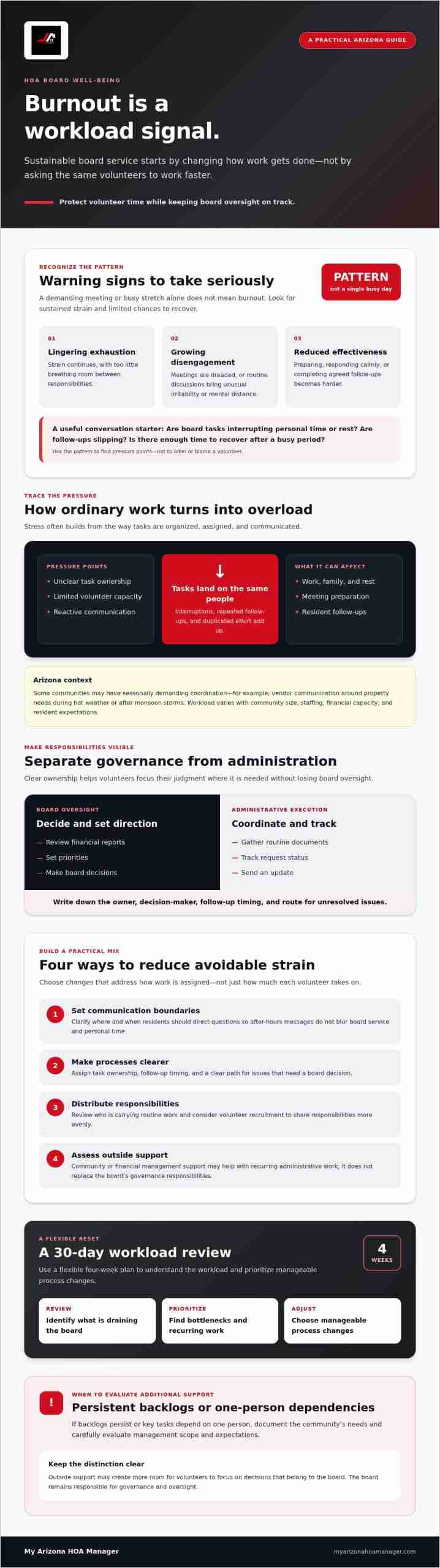
A 30-Day HOA Board Burnout Recovery Plan for Arizona Communities
This four-week sequence is a practical reset for board processes, not a clinical recovery plan or a promise that stress will disappear in 30 days. Adjust the pace to your community’s governing documents, staffing, and available volunteer time. The aim is to identify pressure points, make a few workable changes, and check whether they are helping.
Weeks one and two: identify pressure points and reset expectations
Start with an honest workload inventory. List recurring tasks, who currently handles each one, how often it comes up, and what tends to stall. Include meeting preparation, resident requests, recordkeeping, financial tasks, and vendor coordination. Look for duties with no clear owner, repeated follow-ups, and work that depends on one volunteer.
Then agree on a simple communication routine for non-urgent requests. Set reasonable hours for board communications, choose a standard channel, and explain how requests will be acknowledged and tracked. For urgent matters, follow the community’s established procedures rather than assuming every message needs an immediate response.
Choose one meeting improvement to test. A clearer agenda can separate updates from decisions; a decision log can record what the board agreed to, who owns the next step, and when it should be revisited. Keep the change manageable so it is more likely to become part of the routine.
Weeks three and four: rebalance work and review progress
Use the inventory to redistribute suitable duties. Before assigning a volunteer, confirm their availability and define the task, expected time commitment, and point at which the issue should return to the board. Avoid shifting a vague workload from one person to another. The goal is clear, realistic ownership.
Review outstanding financial and administrative work. Identify what needs a board decision, what can move forward through an agreed process, and where the community may need additional support. If financial processes are a recurring source of delays or extra follow-up, consult this Arizona HOA financial management reference as you assess the work.
At the end of the month, compare the current picture with your starting inventory. Are fewer tasks overdue? Is it clearer who owns follow-ups? Are meetings focused on decisions rather than repeated status checks? These are useful signs to discuss, not proof that every workload problem is solved. If a change is not working, revise it. Effective HOA board member burnout solutions should fit the community’s actual capacity and be adjusted as needs change.
If your review points to recurring financial or administrative work that volunteers cannot sustainably cover, explore HOA financial management support as one option to assess.
When HOA Board Burnout Calls for Outside Support and Clear Next Steps
Outside support may be worth considering when administrative work repeatedly crowds out board oversight, backlogs remain despite process changes, or essential tasks depend on one volunteer’s availability. These patterns do not automatically mean the board needs a management partner. They do signal that it is time to compare the community’s workload with its available capacity.
Before exploring providers, make a short needs assessment. List recurring tasks that are delayed, duplicated, or difficult to cover, and note which responsibilities the board wants to retain. Separate work that requires board judgment from operational tasks that may be handled under an agreed scope. This gives the board a practical basis for evaluating HOA board member burnout solutions without assuming that management will remove every duty or resolve interpersonal disagreements.
Questions to ask before changing or adding management support
Use the same questions to compare options and clarify expectations before signing an agreement:
- Scope: Which recurring administrative and financial tasks would the provider handle, and which remain with the board?
- Communication: How would residents submit requests, and how would board members receive updates or raise concerns?
- Reporting: What financial reporting is included, and how often would the board receive it?
- Transition: What records, access, and open items need to be transferred, and who is responsible for each step?
Ask for responsibilities, service scope, reporting cadence, communication expectations, and transition steps to be documented in writing. Confirm that the proposed arrangement fits the association’s governing documents, capacity, and priorities. The board continues to provide governance and make its decisions; operational support should make responsibilities clearer, not blur accountability.
How an Arizona community management partner may reduce friction
For some communities, professional support with bookkeeping and accounting can help organize recurring financial work, while financial reporting gives the board information to review in its oversight role. An online resident portal can provide a consistent place for community information, and resale document support can help with a defined administrative need. The specific services available and included depend on the agreed scope, so confirm details directly before making a decision.
Look for a fit between the community’s documented needs and the support being considered. If your board is ready to explore whether outside help could address its administrative workload, explore community management support as one option. Asking for help is responsible capacity planning, not a governance failure. A careful review can help the board protect its time while staying engaged in the decisions that guide the community.
Build a More Sustainable Path for Your HOA Board
Reducing volunteer strain starts with noticing patterns, clarifying who owns recurring work, and making board processes easier to follow. The most useful HOA board member burnout solutions fit the community’s real capacity, whether that means setting communication boundaries, sharing appropriate tasks, or reviewing outside support.
A simple workload review can show where requests pile up, financial or administrative tasks keep recurring, and key work depends on one person. Professional support may help with agreed operational responsibilities such as bookkeeping and financial reporting, while the board retains its governance role. My Arizona HOA Manager brings over 30 years of industry experience in community and financial management, but the right next step depends on your association’s needs and the service scope you confirm.
If your board is assessing its capacity, explore community management support for your Arizona HOA. Asking for help is a responsible way to plan for the community’s workload, and small, thoughtful changes can make board service more sustainable.
Frequently Asked Questions
What are the signs of HOA board member burnout?
Signs can include ongoing exhaustion, dreading meetings, irritability during routine discussions, or difficulty completing agreed follow-ups. A volunteer may also feel that board requests regularly intrude on personal time or struggle to recover after a busy period. One stressful week is not enough to identify a pattern. If these changes continue, review the workload and task assignments with the board rather than treating the strain as an individual failing.
How can an HOA board prevent volunteer burnout?
HOA board member burnout solutions work best when they address how the work is organized. List recurring responsibilities, name an owner for each task, set reasonable communication expectations, and use focused agendas to make meetings more manageable. Share appropriate duties only after confirming volunteers’ availability and clarifying what each role involves. Review whether tasks are getting completed, and adjust the process if the same bottlenecks or overload keep returning.
Can an HOA board member resign because of burnout?
A board member may decide to resign, but the process and any consequences depend on the association’s governing documents and applicable requirements. Before acting, review those documents and seek qualified legal guidance if the process is unclear. If the member is open to alternatives, the board can discuss reducing or reassigning tasks, setting clearer boundaries, or arranging additional support. The volunteer’s well-being matters, and the board should also plan for continuity.
How should an HOA board divide work more fairly?
Start by listing the board’s recurring work, current owners, deadlines, and tasks that are falling behind. Keep collective oversight and decisions with the board, then assign suitable administrative or volunteer tasks to named owners with realistic time expectations. Make clear who follows up, when an issue returns for board discussion, and how progress is shared. Fair distribution does not always mean identical workloads; account for each volunteer’s capacity and the task’s demands.
When should an HOA hire a community management company?
Consider outside support when administrative backlogs persist, essential tasks rely on one person, or recurring work leaves too little time for board oversight. First document which tasks need help and what responsibilities the board wants to retain. HOAs in Scottsdale, Phoenix, Mesa, Tucson, Glendale, Chandler, Avondale, Litchfield Park, Maricopa, Goodyear, Surprise, Peoria, Tempe, Fountain Hills, Cave Creek, and Anthem can compare their needs with available community management scope before making a decision.
Can professional HOA management eliminate board member burnout?
No management arrangement can promise to eliminate burnout or resolve every source of board stress. Professional support may help with agreed operational work such as bookkeeping, accounting, financial reporting, online resident portals, or resale documents. The board still retains its governance responsibilities and decisions. Before entering an agreement, confirm the scope, communication process, reporting expectations, and transition responsibilities so the support addresses actual workload pressures.
How can Arizona HOA boards make meetings less stressful?
Use a clear agenda that separates routine updates from items needing discussion or a board decision. Share relevant information in advance, identify the purpose of each decision item, and record assigned follow-ups so the same questions do not repeatedly consume meeting time. Set a predictable channel for non-urgent resident requests and status updates. Review the association’s governing documents and seek qualified advice when needed to ensure meeting practices fit the community’s requirements.