
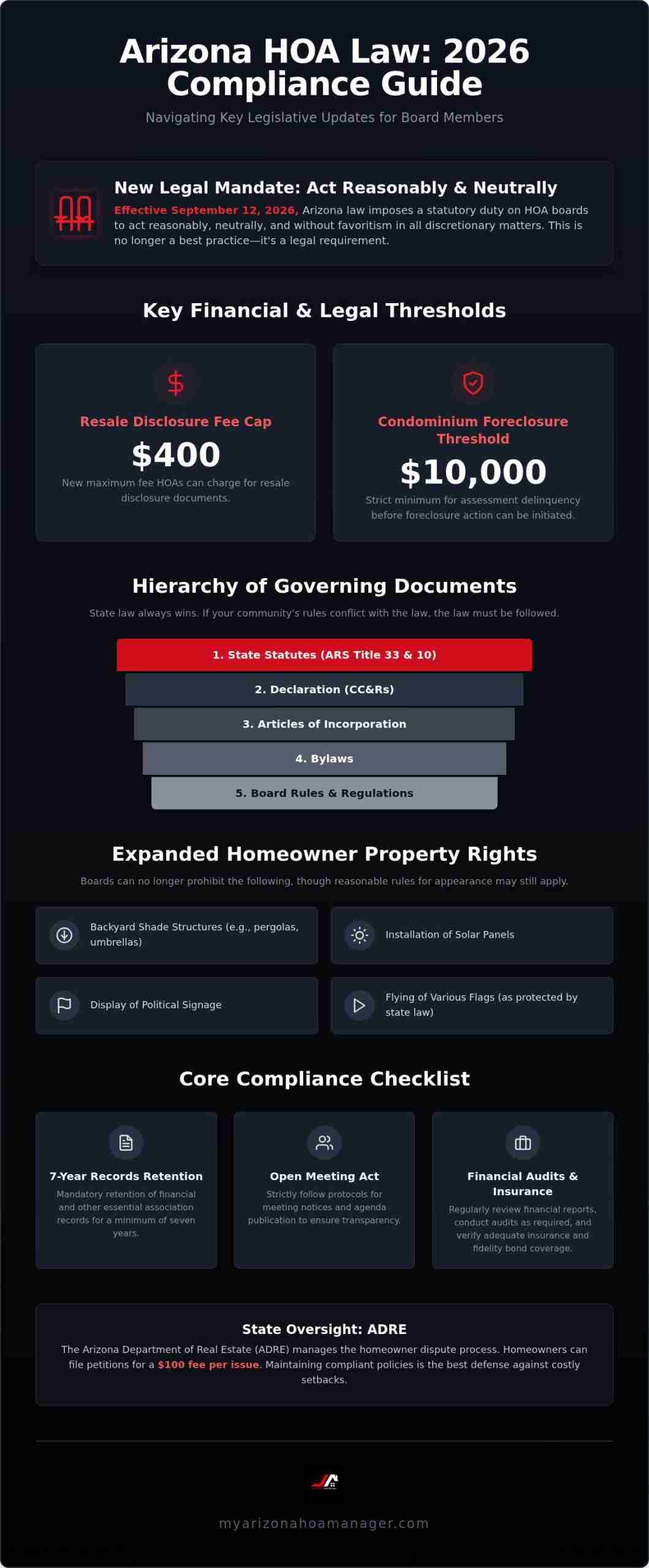
Did you know that as of September 12, 2026, Arizona law now imposes a statutory duty on your HOA board to act reasonably, neutrally, and without favoritism in every discretionary matter? It isn’t just a best practice anymore; it’s a legal mandate that requires specific Arizona HOA legislative compliance help to navigate correctly. If you feel like the goalposts for community governance move every time the state legislature meets, you aren’t alone. Deciphering the differences between ARS Title 33 and Title 10 while managing resident disputes is a heavy lift for any volunteer leader. Compliance shouldn’t feel like a moving target.
This resource provides a clear roadmap for managing the 2026 updates, from the new $400 resale disclosure fee caps to the strict $10,000 foreclosure thresholds for condominiums. We’ll explore practical ways to streamline your document management and meet transparency requirements through professional tools like resident portals. You’ll gain the specific insights needed to reduce the risk of complaints to the Arizona Department of Real Estate and keep your community’s operations steady and predictable. By focusing on these operational habits, you can protect your board from unnecessary liability and foster a more harmonious neighborhood.
Key Takeaways
- Understand the critical distinctions between ARS Title 33 and Title 10 to ensure your board’s governance aligns with the correct legal framework for Arizona planned communities.
- Access expert Arizona HOA legislative compliance help to master the expanded 2026 financial reporting standards and the mandatory seven-year records retention requirements.
- Learn the essential notice and agenda protocols required by the Open Meeting Act to maintain transparency and prevent costly resident disputes.
- Follow a step-by-step internal audit checklist to identify gaps in your community’s insurance coverage and fidelity bonds before they become operational liabilities.
- Evaluate the cost-benefit of professional financial management to see how streamlined resident portals can handle the “nuts and bolts” of administration for volunteer boards.
Understanding the Landscape of Arizona HOA Legislation in 2026
2026 is a milestone year for community leadership. The Arizona State Legislature has introduced a wave of reforms that shift the balance of power toward homeowners, making Arizona HOA legislative compliance help more vital than ever. For a board member, staying compliant means looking past your internal bylaws and understanding the state’s broader legal framework. If you don’t keep up, you risk enforcing rules that are no longer legally valid.
Most associations operate as non-profit corporations, which places them under the jurisdiction of ARS Title 10. However, the specific “rules of the road” for community living are found in ARS Title 33. While Title 10 handles how you run a board meeting or elect officers, Title 33 dictates what you can actually enforce regarding property use. If your CC&Rs conflict with state law, the state law wins every time. This hierarchy is a foundational concept in Understanding Homeowner Associations and their legal limitations.
The Arizona Department of Real Estate (ADRE) provides the primary oversight for these regulations. They manage the dispute process, where homeowners can file petitions for $100 per issue. Because the ADRE strictly follows the letter of the law, boards must ensure their policies are legally sound to avoid costly setbacks. Professional management acts as a stabilizer here, ensuring that your board isn’t blindsided by a complaint filed over an outdated policy.
The Core Statutes: ARS § 33-1801 through 33-1818
These specific sections of Title 33 serve as the primary authority for planned communities in Arizona. They outline everything from assessment collection to open meeting requirements. Under Arizona law, a planned community is a real estate development where owners are mandatory members of an association and are required to pay assessments for the maintenance of common areas. This definition is the trigger for all Title 33 requirements.
When conflicts arise, remember the hierarchy of documents. State statutes sit at the top, followed by your Declaration (CC&Rs), then your Articles of Incorporation, Bylaws, and finally, Board Rules. You cannot use a board rule to bypass a requirement set in ARS § 33-1804 regarding open meetings. If your bylaws say you don’t have to give notice for a certain meeting, but Title 33 says you do, you must follow the statute.
Recent Legislative Trends Affecting Arizona Boards
The trend for 2026 is clear: transparency and “reasonableness.” As of September 12, 2026, boards have a statutory duty to act reasonably and neutrally in all discretionary matters. This law aims to eliminate favoritism in rule enforcement. It’s a significant shift that requires boards to document their decision-making process more carefully than in years past.
Other major shifts involve homeowner rights to property use. Boards can no longer prohibit backyard shade structures like pergolas or umbrellas, though they can still set reasonable rules for appearance. We also see continued protections for solar panels, political signage, and various flags. These “hiccups” often occur when a board tries to enforce an outdated section of their CC&Rs that hasn’t been updated to reflect these new state-level protections. Seeking Arizona HOA legislative compliance help ensures your board isn’t enforcing “ghost rules” that no longer hold up in court.
Key Compliance Pillars: Financial Reporting and Records Retention
Financial transparency isn’t just a goal; it’s a legal requirement that keeps your association out of the Arizona Department of Real Estate’s crosshairs. When a board fails to provide clear financial records, it creates a vacuum of trust that often leads to formal complaints. Reliable Arizona HOA legislative compliance help is most effective when it focuses on these financial pillars before a dispute ever arises. Effective Arizona HOA financial compliance involves more than just balancing a checkbook; it requires a methodical approach to reporting and record-keeping that satisfies both state law and resident expectations.
Standardizing Your Financial Documentation
Accurate bookkeeping is the foundation for every other administrative duty. Without it, you can’t complete your required annual tax filings or provide the detailed financial statements now required in resale disclosure packets. As of September 12, 2026, these packets must include board meeting minutes, current financial statements, and reserve studies. Many boards find that seeking professional HOA tax filing assistance Arizona prevents the “hiccups” that occur during audit season. 2026 standards also emphasize the importance of regular reserve study updates to ensure the association remains financially viable over the long term. For ongoing education on these standards, the CAI Arizona Chapter Resources offer excellent guidance for board members who want to stay ahead of shifting regulations.
Open Records Requests: Navigating ARS § 33-1805
Arizona law is specific about a resident’s right to inspect association records. Under ARS § 33-1805, boards generally have 10 business days to fulfill a request for records. However, you must be careful not to release protected information. Private personnel records, individual member financial data, and documents covered by attorney-client privilege must remain confidential. Best practices for Arizona HOA legislative compliance help suggest keeping financial records like bank statements and vendor invoices for seven years, while foundational documents like CC&Rs and meeting minutes must be kept permanently. Managing these requests manually is a common administrative challenge. An online resident portal resolves this by providing a secure, centralized location where members can access non-confidential documents instantly. This proactive approach reduces the administrative burden on volunteers while ensuring you stay on the right side of the law.
A professional Financial Management service can help establish these automated systems, turning compliance into a background process rather than a monthly emergency.
Navigating Resale Disclosures and Arizona Meeting Requirements
A board’s liability often hinges on two critical areas: what happens behind closed doors and what is disclosed during a property sale. In a high-turnover market like Phoenix or Tucson, managing these administrative “nuts and bolts” requires precision to avoid legal friction. Obtaining Arizona HOA legislative compliance help is especially critical when handling resale certificates, as the rules for what must be shared with a potential buyer became significantly more stringent in 2026. Transparency isn’t just a neighborly courtesy; it’s a statutory mandate that protects the association from future claims of nondisclosure.
Resale Document Processing in 2026
Under ARS § 33-1806, the board has a strict duty to provide accurate disclosure statements to prospective buyers. As of September 12, 2026, the maximum fee an association can charge for a resale disclosure packet is capped at $400. This fee can only be collected at the close of escrow. It’s vital to ensure these packets are complete, as the law now requires the inclusion of board meeting minutes, current financial statements, and reserve studies. Providing outdated or incomplete information doesn’t just frustrate a sale; it opens the board to liability if a new owner discovers undisclosed assessments or pending litigation. For a detailed list of every required form, see our guide on Arizona HOA resale disclosure requirements.
Professional resale services act as a stabilizer during these transactions. By automating the collection of insurance disclosures and assessment histories, you ensure that every packet meets the 2026 standards without placing a heavy burden on volunteer board members. This methodical approach reduces the risk of “hiccups” that could derail a closing or result in an ADRE complaint.
Meeting Compliance: Notice and Transparency
Arizona’s “Open Meeting Act” requirements are designed to keep residents informed and involved. Boards must provide at least 48 hours of notice to the community before any meeting, along with a clear agenda. This notice is a foundational requirement; if you don’t post it correctly, any decisions made during that meeting could be challenged and overturned. Accurate minutes serve as the legal record of your compliance, documenting that the board acted reasonably and followed proper protocols. If your board records these meetings, remember that you must keep the unedited recording for at least six months and provide copies to members upon request.
Executive sessions are another area where boards often face scrutiny. These private sessions are strictly limited to topics like legal advice, personnel matters, or discussions regarding a member’s personal financial delinquency. You cannot use an executive session to bypass the community on general business or policy changes. Navigating these boundaries is much easier with Arizona HOA legislative compliance help, which provides the structure needed to keep your meetings productive and legally sound. This is particularly important during the transition from developer control to homeowner governance, a pivotal moment where setting a standard of transparency establishes long-term community harmony.
Implementing a Compliance Audit: A Board Member’s Checklist
Waiting for a homeowner complaint to trigger a review of your association’s policies is a risky strategy. A proactive compliance audit acts as a stabilizer, catching small “hiccups” before they turn into expensive legal disputes. By conducting a methodical internal review each year, your board demonstrates that it’s acting reasonably and neutrally, as required by the 2026 legislative updates. This process doesn’t have to be overwhelming; it’s about checking the “nuts and bolts” of your community’s governance to ensure everything aligns with current Arizona law. Reliable Arizona HOA legislative compliance help starts with a clear, actionable checklist.
The Annual Governance Review
Your first step is verifying your association’s standing with the Arizona Corporation Commission. If your corporate status lapses, your board may lose its legal protections, leaving members vulnerable. Once your status is confirmed, ensure every board member has reviewed the latest legislative updates for 2026. This includes understanding the new “duty to act reasonably” and the specific thresholds for foreclosure. Use a dedicated Arizona HOA legislative compliance help checklist to audit your existing CC&Rs and Bylaws. If you find rules that prohibit backyard shade structures or mandate water-intensive lawns during a drought, those sections need immediate updates to remain enforceable under state law.
Insurance coverage is another critical pillar of your governance review. Check your directors and officers (D&O) liability insurance and verify that your fidelity bonds meet the requirements set in your governing documents. As property values and assessment totals rise, your coverage limits may need adjustment to fully protect the association’s assets.
Vendor and Contract Compliance
Reviewing vendor contracts is often overlooked during an audit, yet it’s a common source of friction. Many older contracts contain “evergreen clauses” that automatically renew, potentially locking the association into outdated terms that conflict with new regulations. You should verify that every vendor, from landscaping to pool maintenance, carries the appropriate insurance levels. If a vendor is underinsured, the association could be held liable for accidents on common property. When it’s time to refresh your service providers, refer to our guide on how to find HOA vendors in Arizona to ensure you’re vetting for both quality and legal compliance.
Finally, examine how you update community rules. Any new rule must be passed in an open meeting with proper notice, and it cannot violate the homeowner rights established in ARS Title 33. If your board feels overwhelmed by these administrative demands, partnering with a professional Community Management specialist can streamline the audit process and keep your records organized and accessible.
Professional Management vs. DIY Compliance: Finding Help in Arizona
Many boards feel they must call an attorney for every legislative update. While legal counsel is essential for complex litigation or rewriting your CC&Rs, the vast majority of 2026 requirements are operational in nature. Deciding when to hire a lawyer versus a management firm often comes down to the difference between legal interpretation and daily execution. Seeking Arizona HOA legislative compliance help through a professional management partner often provides a more cost-effective solution for the “nuts and bolts” of administration. Most compliance issues arise from missed deadlines or incomplete records; these are management challenges that don’t always require a billable legal hour.
For small Arizona HOAs, the cost-benefit analysis of professional financial management is clear. Self-managed boards often struggle with the technical requirements of ARS Title 33, leading to “hiccups” in resale disclosures or audit preparation. A dedicated financial partner ensures that your balance sheets, reserve studies, and assessment collections are handled with professional precision. This reduces the risk of friction with residents and lowers the likelihood of costly fines or ADRE petitions. By outsourcing the technical heavy lifting, volunteer leaders can focus on community building rather than paperwork.
The Value of a Dedicated Compliance Partner
Professional managers act as educators and stabilizers for the board. Instead of reacting to legislative changes with panic, you can rely on a partner who has already integrated those changes into your community’s workflow. This proactive approach fosters a sense of “quiet confidence” among board members. When your bookkeeping is transparent and your reporting is methodical, resident trust naturally increases. Expert handling of administrative tasks, such as managing the resident portal or processing resale documents, removes the burden from volunteers and ensures the association operates like a well-oiled machine.
Next Steps for Your Arizona HOA Board
Securing your association’s future in Phoenix, Tucson, or Mesa requires a clear plan of action. The transition from a self-managed model to professional support doesn’t have to be a disruptive event. It starts with a thorough review of your current standing to identify any existing compliance gaps. Boards should prioritize a professional financial review to ensure their records meet the 2026 standards for transparency and retention. This baseline assessment provides the clarity needed to make informed decisions about your community’s long-term health.
If your board is ready to move away from the stress of DIY management and toward a more stable governance model, we are here to help. Our team specializes in the specific requirements of Arizona law, providing the “boots-on-the-ground” support your community needs to thrive. Contact My Arizona HOA Manager for a compliance consultation today and let us help you navigate the complexities of 2026 with ease.
Securing Your Community’s Future in 2026 and Beyond
2026 represents a significant shift toward homeowner protection and board accountability across the state. From mastering the nuances of ARS Title 33 to managing the strict 10-day window for open records requests, the “nuts and bolts” of governance have never been more demanding. Staying ahead of these changes isn’t just about avoiding fines; it’s about building a stable, harmonious environment where residents feel respected. When your board prioritizes transparency and follows a methodical audit process, you protect the association’s long-term health.
Accessing professional Arizona HOA legislative compliance help allows your board to move from a reactive state to a proactive one. With over 30 years of industry experience and localized expertise in Arizona Title 33, our team provides the comprehensive financial and administrative support you need to handle every legislative “hiccup” with ease. Secure your community’s future with My Arizona HOA Manager and experience the quiet confidence that comes with expert oversight. You don’t have to navigate these complex requirements alone; we’re here to help your community thrive.
Frequently Asked Questions
Is our Arizona HOA required by law to have a professional audit every year?
Arizona law requires an annual financial audit or review for associations with annual revenues of $50,000 or more. If your community in Phoenix or Mesa meets this threshold, the board must provide these results to members. It’s a key part of maintaining transparency and resident trust. For smaller associations, professional bookkeeping ensures your records are ready if a review is requested. Following these standards is a critical step in achieving Arizona HOA legislative compliance help.
How much notice must we give residents before an Arizona HOA board meeting?
You must provide at least 48 hours of notice to residents before any board meeting in Arizona. This notice must include a clear agenda and be posted in a conspicuous place within the community or on your resident portal. In cities like Scottsdale and Chandler, failing to provide proper notice can invalidate board decisions. Keeping a consistent schedule helps you avoid operational hiccups and ensures your community stays informed about upcoming governance matters.
Can an Arizona homeowner request to see the HOA’s bank statements?
Yes, homeowners have a statutory right to inspect association records, which include bank statements and financial reports. Under ARS § 33-1805, boards generally have 10 business days to fulfill these requests. However, you shouldn’t release sensitive information like individual member delinquency details or personnel records. Using an online resident portal simplifies this process for boards in Tucson and Peoria by making non-confidential financial documents easily accessible to all members who wish to see them.
What happens if our Arizona HOA rules conflict with a new state law?
State law always takes precedence over your association’s governing documents. If a new statute, like the 2026 duty to act reasonably law, contradicts your existing CC&Rs or Bylaws, the board must follow the state law. Enforcing outdated rules can lead to expensive legal disputes or complaints to the Arizona Department of Real Estate. Seeking Arizona HOA legislative compliance help ensures your board identifies these conflicts before they become a liability for your community in Litchfield Park.
Do Arizona HOAs have to register with the state every year?
Yes, most Arizona HOAs are incorporated as non-profit entities and must file an annual report with the Arizona Corporation Commission. This filing keeps your association in good standing and protects your corporate status. If you don’t file, your board could lose its legal protections. Boards in Glendale and Maricopa should also ensure their community information is updated with the state to maintain full operational compliance and avoid unnecessary administrative friction.
What are the limits on HOA resale disclosure fees in Arizona for 2026?
As of September 12, 2026, the maximum fee an HOA can charge for a resale disclosure packet is capped at $400. You can charge an additional rush fee of up to $100 for delivery within 72 hours. If 30 days have passed since the original request, an update fee of up to $50 is also permissible. These fees can only be collected at the close of escrow, which is a standard practice for associations in Goodyear and Tempe.
Can an HOA board in Arizona hold a secret meeting?
No, Arizona law requires board meetings to be open to all members, with very specific exceptions. Boards can only meet in executive session to discuss legal advice, personnel issues, or a member’s personal financial delinquency. You can’t use these private sessions to make general business decisions or bypass transparency rules. Maintaining open meetings is a foundational requirement for associations in Anthem and Surprise to ensure every resident has a voice in community governance and policy.
How long are we required to keep HOA financial records in Arizona?
While some statutes require a three-year retention period, the best practice for Arizona HOAs is to keep financial records for seven years. This includes bank statements, tax returns, and vendor invoices, which aligns with IRS audit timelines. Foundational documents like your CC&Rs and meeting minutes must be kept permanently. Professional financial management services help boards in Fountain Hills and Cave Creek organize these records, ensuring they’re always ready for a resident inspection or state audit.